
Hello Operators.
This tutorial shows how to power a 100W ham radio off-grid using portable solar panels, a LiFePO4 battery, and MPPT charge controllers. The system is built step by step, including the battery, solar panels, charge controllers, cabling, and Powerpole connections.
The system is built around the Icom IC-7300 Mk2, two PowerFilm crystalline solar panels, two Genasun GV-10-Li-14.2V MPPT charge controllers, a Power Queen 12.8V 50Ah LiFePO4 battery, and a Windcamp AP-8 power distribution board.
Why the Icom IC-7300 Mk2 Makes Sense Off-Grid
For years, I relied on QRP radios with external amplifiers to balance power consumption and capability. The Icom IC-7300 Mk2 changes that equation. It delivers the full 100 watts without the heavy receive-current penalty normally associated with a full-power HF radio.
Receive current matters because a radio spends far more time listening than transmitting. QRP radios typically draw anywhere from roughly 100mA to 800mA on receive, while many 100W radios draw between 1A and 2A. The IC-7300 Mk2 draws approximately 0.7A on receive, placing it close to the upper end of the QRP range while retaining full 100W capability.
Reducing the transmit power of a 100W radio does not reduce its receive current. A radio drawing 2A while listening will continue drawing approximately 2A whether the transmit power is set to 5W, 10W, or 100W. This is why the IC-7300 Mk2’s lower receive current is so useful for an off-grid station.
This is the strongest argument for the system.
- Approximately 700mA receive current for prolonged monitoring
- Full 100W transmit capability when the mission requires it
- A lightweight 50Ah LiFePO4 battery
- Solar or generator charging to restore the energy consumed
Proving the System in the Field
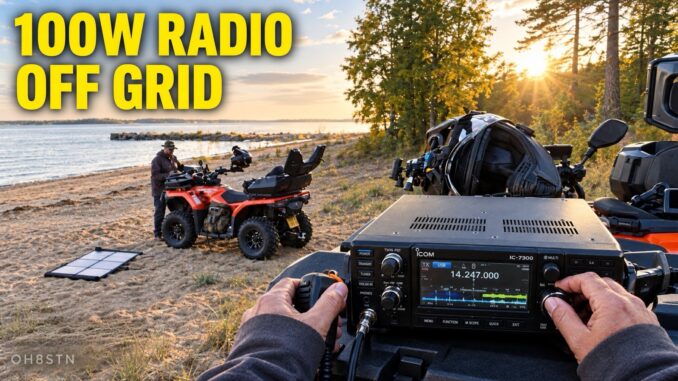
The video begins on the beach with the ATV and Icom IC-7300 Mk2. Running from the Power Queen battery, the radio makes a 100W SSB voice contact with a station in Ukraine. The battery is supported by the two portable PowerFilm solar panels through their independent Genasun MPPT charge controllers.
After the contact, we build the system and show every connection in practice.
Portable Solar Power System
The system uses two PowerFilm folding panels from the Crystalline series. One is rated at 135 watts and the other at 110 watts. I didn’t have a second 110-watt PowerFilm panel from the Crystalline series, so I used the 135-watt panel as a substitute. The dual-panel arrangement follows the “two is one, one is none” redundancy principle. The meaning behind this setup will reveal itself in the coming days and weeks.
Each PowerFilm panel connects to its own Genasun GV-10-Li-14.2V MPPT charge controller. As mentioned in the video, I used the Genasun GV-10-Li-14.2V for 4S LiFePO4 batteries. As with the solar panels, the charge controllers are also redundant.
I chose the Genasun controllers because they offer the best performance with the least amount of RF hash or noise. If a charge controller creates more noise than the signal we are trying to pull in, our communications strategy will fail!
Both Genasun controllers feed the same Power Queen 50Ah LiFePO4 battery. I chose the 50Ah LiFePO4 battery because it is lightweight and provides usable capacity comparable to a 100Ah lead-acid battery, without the severe Peukert losses of lead-acid chemistry.
I chose Power Queen because the company has provided excellent sales and support to my subscribers over the years and continues to support the channel.
The Power Queen 50Ah LiFePO4 battery connects to the Windcamp AP-8 Powerpole distribution board. In the field test, the battery and both Genasun charge controllers were each connected to separate Powerpole ports on the AP-8. The remaining ports supply power to the radio and other station equipment.
In the tutorial, we:
- Field-test the solar panels and battery with the Icom IC-7300 Mk2
- Prepare and crimp the Powerpole contacts
- Install wire ferrules
- Use separate connector colors for the panels and battery connections
- Build the controller-to-battery cables
- Build the SAE-to-Powerpole solar-panel cables
- Check voltage, polarity, and continuity
- Connect the first controller and solar panel
- Connect the second controller and solar panel
- Confirm that both controllers are charging the battery
- Connect the Windcamp AP-8 power distribution board
Equipment and Discount Links
PowerFilm Crystalline Solar Panels
Available from California PC & Peripherals.
Discount code: OH8STN
110W panel shown in the video:
https://www.californiapc.com/Portable-Solar-Chargers/PowerFilm-Solar-Foldable-Solar-Panels/F3-32F18.9VBLKS
135W panel shown in the video:
https://www.californiapc.com/Portable-Solar-Chargers/PowerFilm-Solar-Foldable-Solar-Panels/F3-40F23.6VBLKS
Genasun MPPT Charge Controllers
Two Genasun GV-10-Li-14.2V controllers are used, one for each panel. This model is configured for 4S LiFePO4 batteries.
Discount code: 5forOH8STN
USA: Select GV-10-Li-14.2V-RETAIL under Lithium.
https://sunforgellc.com/product/gv-10/
Europe:
https://genasun.eu/products/genasun-gv-10-lithium-14-2-volt-mppt
Power Queen 12.8V 50Ah LiFePO4 Battery
Discount code: JULIANOH8STN
Affiliate links:
USA: https://ipowerqueen.com/?ref=0q1c0pan
Europe: https://www.ipowerqueen.de/?ref=732d60hj
Canada: https://ca.ipowerqueen.com/?ref=y0igztbu
UK: https://uk.ipowerqueen.com/?ref=k0j3c653
Windcamp AP-8 Power Distribution Board
eBay affiliate link:
https://ebay.us/xDXLyQ
Affiliate disclosure: Purchases through links marked as affiliate links may earn me a commission at no additional cost to you.
Related Battery Builds
Ham Radio Battery Pack DIY LiFePO4
https://www.youtube.com/watch?v=SJGKuriGRok
Ham Radio Battery Pack DIY LiFePO4 | Headway 38120
https://www.youtube.com/watch?v=nDoQoVA0hAc
Books for Your Off-Grid Station
These books expand on the station planning and portable-power work demonstrated in this project.
Ham Radio Field Day on Solar Power:
https://www.amazon.com/dp/B0H6K18DK7
Off-Grid Power for Emergency Communications:
https://www.amazon.com/dp/9526564529
Find my books on your local Amazon marketplace or visit:
https://www.amazon.com/author/julian-oh8stn
Duty Cycle and Operating Efficiency
The mission driving this system is a portable Hybrid Winlink RMS Gateway. While an internet connection remains available, the gateway can connect to the Winlink Common Message Servers. If grid-tied communications fail, it can continue moving traffic through radio-only links.
An RMS Gateway spends much of its operating time listening and waiting for incoming connections. Receive-current consumption is therefore not a minor specification. It is one of the primary factors determining how much battery capacity the station requires and how long it can remain operational between charging periods.
Carrying massive lead-acid batteries into the field is inconceivable for this mission. Smaller, lighter LiFePO4 batteries combined with an efficient HF radio allow us to carry less weight while maintaining the operating time required to keep the gateway available.
The IC-7300 Mk2 also removes the complexity of using a QRP radio with an external amplifier. That approach can provide low receive-current consumption and 100W transmit capability, but it requires another powered device, additional cabling, additional connections, and more potential points of failure. The IC-7300 Mk2 provides approximately 700mA receive current and full 100W transmit capability in one radio.
For the following comparisons, both radios draw 20A while transmitting. The IC-7300 Mk2 draws approximately 0.7A while receiving, while the comparison radio draws 2A. The figures show how much energy the lower receive current saves and how much additional operating time that saving represents at the same duty cycle.
10% Transmit / 90% Receive
This is a useful planning model for a gateway spending most of its time monitoring for incoming connections.
The 2A receive-current radio averages 3.8A. The IC-7300 Mk2 averages 2.63A.
- 24 hours: 28.08Ah saved, providing approximately 10 hours 41 minutes of additional operating time
- 48 hours: 56.16Ah saved, providing approximately 21 hours 21 minutes of additional operating time
- 72 hours: 84.24Ah saved, providing approximately 32 hours 2 minutes of additional operating time
20% Transmit / 80% Receive
The 2A receive-current radio averages 5.6A. The IC-7300 Mk2 averages 4.56A.
- 24 hours: 24.96Ah saved, providing approximately 5 hours 28 minutes of additional operating time
- 48 hours: 49.92Ah saved, providing approximately 10 hours 57 minutes of additional operating time
- 72 hours: 74.88Ah saved, providing approximately 16 hours 25 minutes of additional operating time
30% Transmit / 70% Receive
The 2A receive-current radio averages 7.4A. The IC-7300 Mk2 averages 6.49A.
- 24 hours: 21.84Ah saved, providing approximately 3 hours 22 minutes of additional operating time
- 48 hours: 43.68Ah saved, providing approximately 6 hours 44 minutes of additional operating time
- 72 hours: 65.52Ah saved, providing approximately 10 hours 6 minutes of additional operating time
The IC-7300 Mk2 is not pretending to be a tiny QRP transceiver. Its advantage is that the lower receive-current consumption keeps the continuous station load manageable while retaining 100W transmit capability when the mission requires it.
Combined with a lightweight 50Ah LiFePO4 battery and periodic charging from solar panels or a generator, that makes the IC-7300 Mk2 a viable radio for a portable Hybrid RMS Gateway—not merely a base-station radio carried into the field.
Video Chapters
- 00:00 How to power a 100W ham radio with solar
- 00:24 Icom IC-7300 Mk2 portable: 100W SSB contact with Ukraine
- 02:08 Portable ham radio solar power system
- 05:16 Genasun GV-10-Li-14.2V MPPT charge controllers
- 06:12 Ferrules and connector color coding
- 08:49 Preparing and crimping Powerpole contacts
- 13:57 Wiring the PowerFilm solar panels
- 17:15 Building the controller’s battery cable
- 25:41 Two completed charge controllers
- 26:08 Making SAE-to-Powerpole solar cables
- 31:05 Checking continuity and wiring
- 34:53 Testing the battery and solar panels
- 38:37 Connecting the first charge controller and panel
- 40:12 Connecting the second controller and panel
- 41:39 Windcamp AP-8 power distribution
- 42:38 SSB contact with Ukraine, continued
More field tests and tutorials:
https://oh8stn.org
73
Julian OH8STN
