
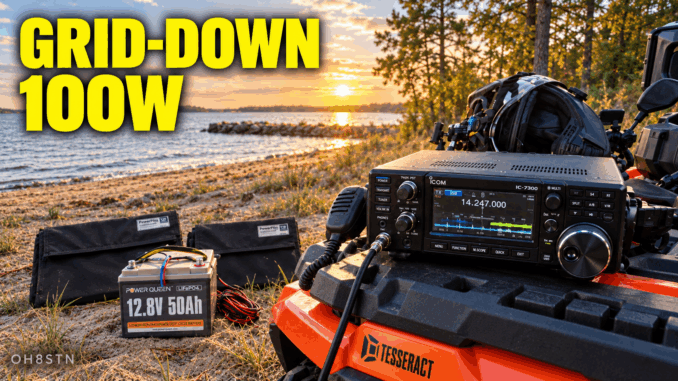
Hello Operators.
Recently, I published a video detailing how to wire our solar and battery power system for a 100W field-deployed radio. This wasn’t just a random video idea. It had a specific mission behind it.
The Mission Behind the Power System
The mission is a portable Hybrid Winlink RMS Gateway for grid-down emergency communications. That requires an off-grid power system capable of sustaining a 100W HF radio during a remote deployment.
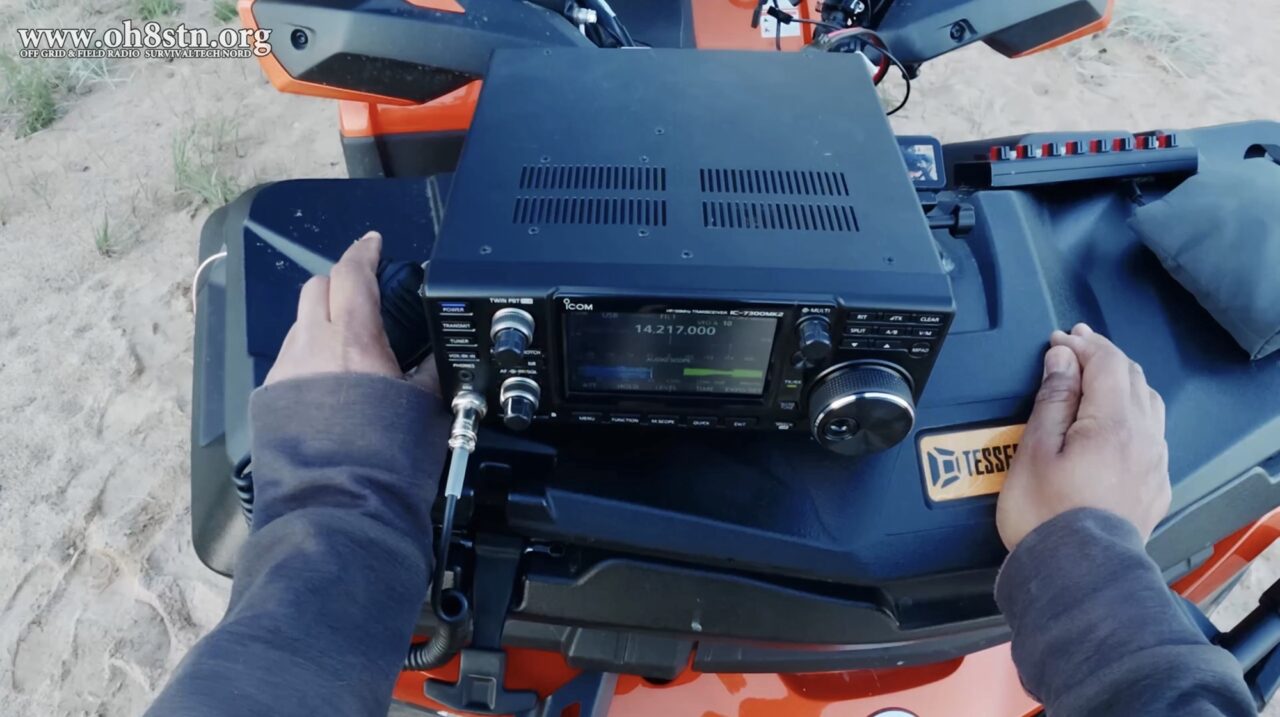
During remote deployment, Starlink would provide the gateway’s connection to the Winlink Common Message Servers. If local grid-tied communications fail, the gateway can remain connected through Starlink. If that internet path is also lost, the Hybrid RMS Gateway can continue moving traffic through radio-only links.
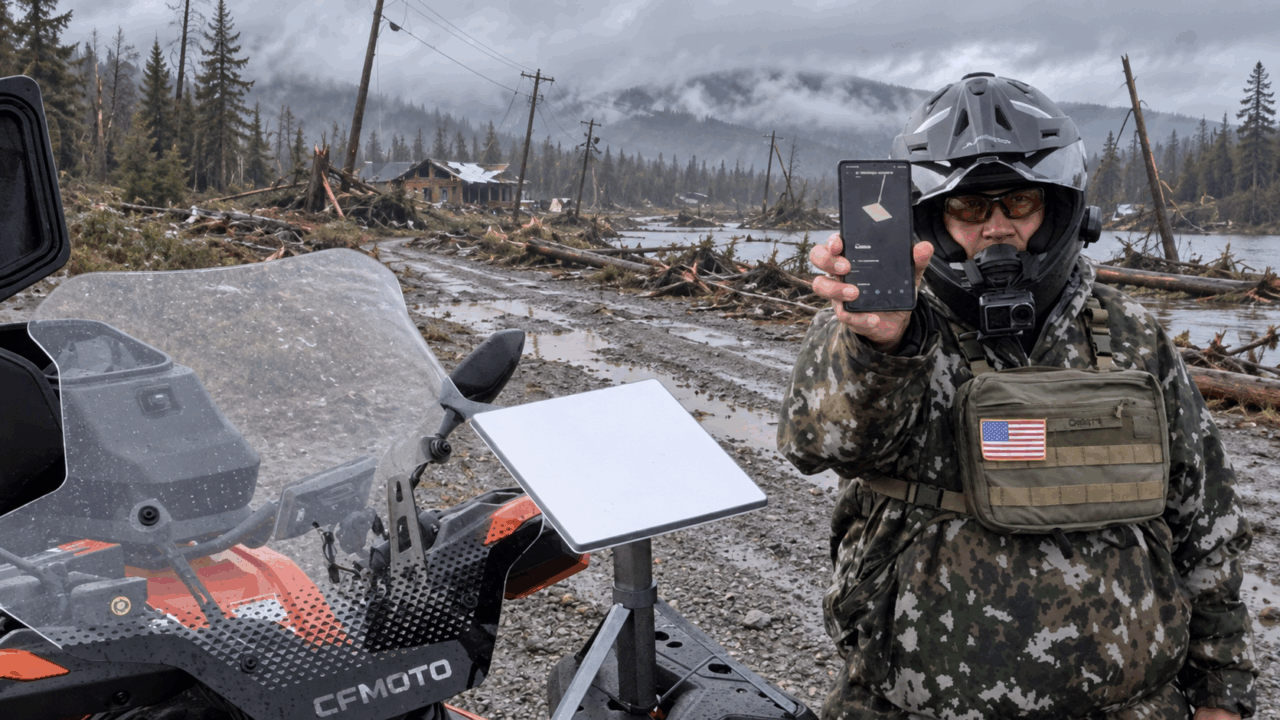
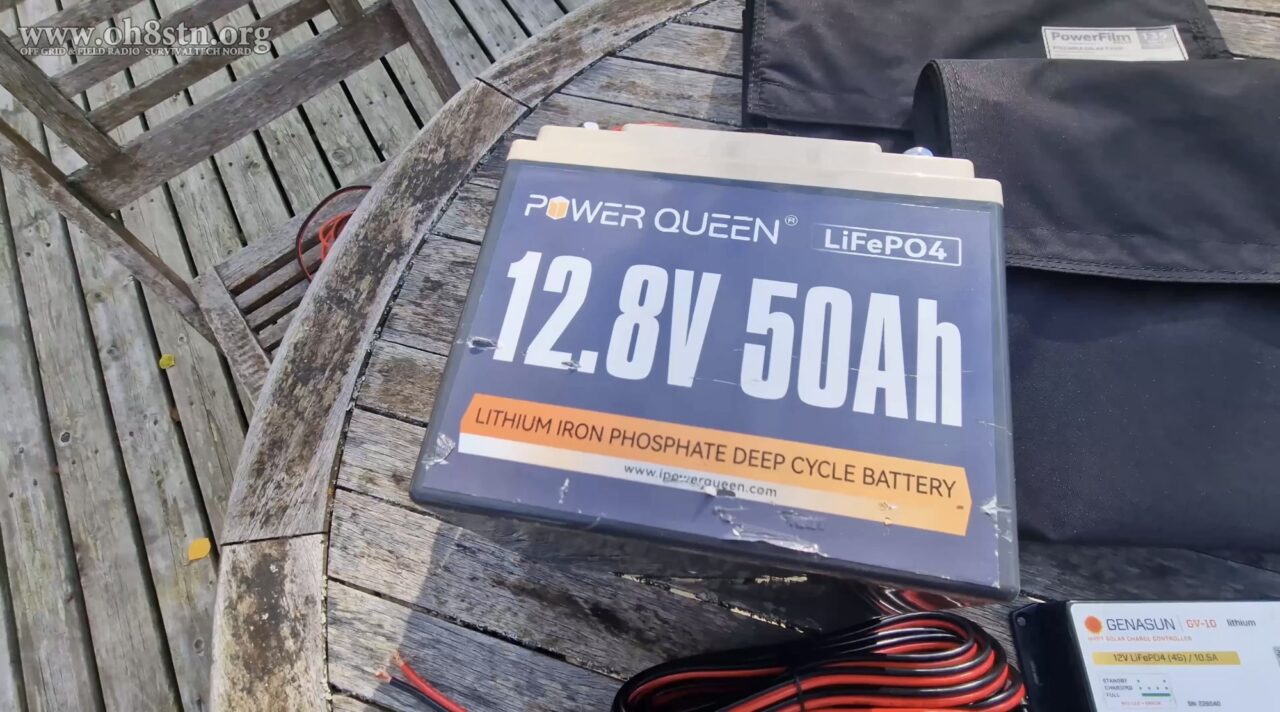
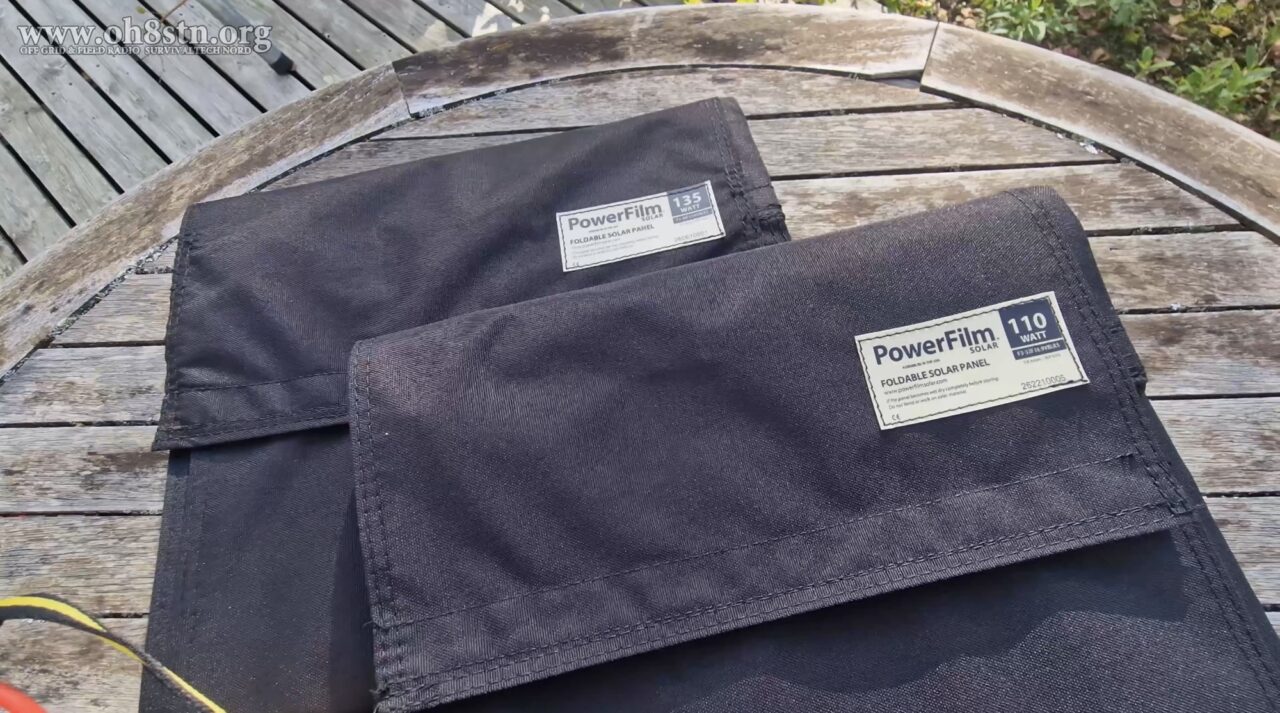
The power system uses two folding PowerFilm crystalline solar panels, one rated at 110W and the other at 135W, providing 245W of nominal solar capacity. Each panel connects to its own Genasun GV-10-Li-14.2V MPPT charge controller, creating two independent charging paths for redundancy. Both controllers support the same Power Queen 12.8V 50Ah LiFePO4 battery, while the Windcamp AP-8 Powerpole distribution board provides a central connection point for the battery, charging sources, radio, and supporting station equipment.
We could certainly build a solar and battery system capable of powering practically any current-hungry HF radio on the market. However, choosing the wrong radio increases the required battery capacity, solar recovery time, generator runtime, system weight, and overall complexity.
The Portable Power Platform
The power system uses two folding PowerFilm crystalline solar panels, one rated at 110W and the other at 135W, providing 245W of nominal solar capacity. Each panel connects to its own Genasun GV-10-Li-14.2V MPPT charge controller, creating two independent charging paths for redundancy. Both controllers support the same Power Queen 12.8V 50Ah LiFePO4 battery, while the Windcamp AP-8 Powerpole distribution board provides a central connection point for the battery, charging sources, radio, and supporting station equipment.
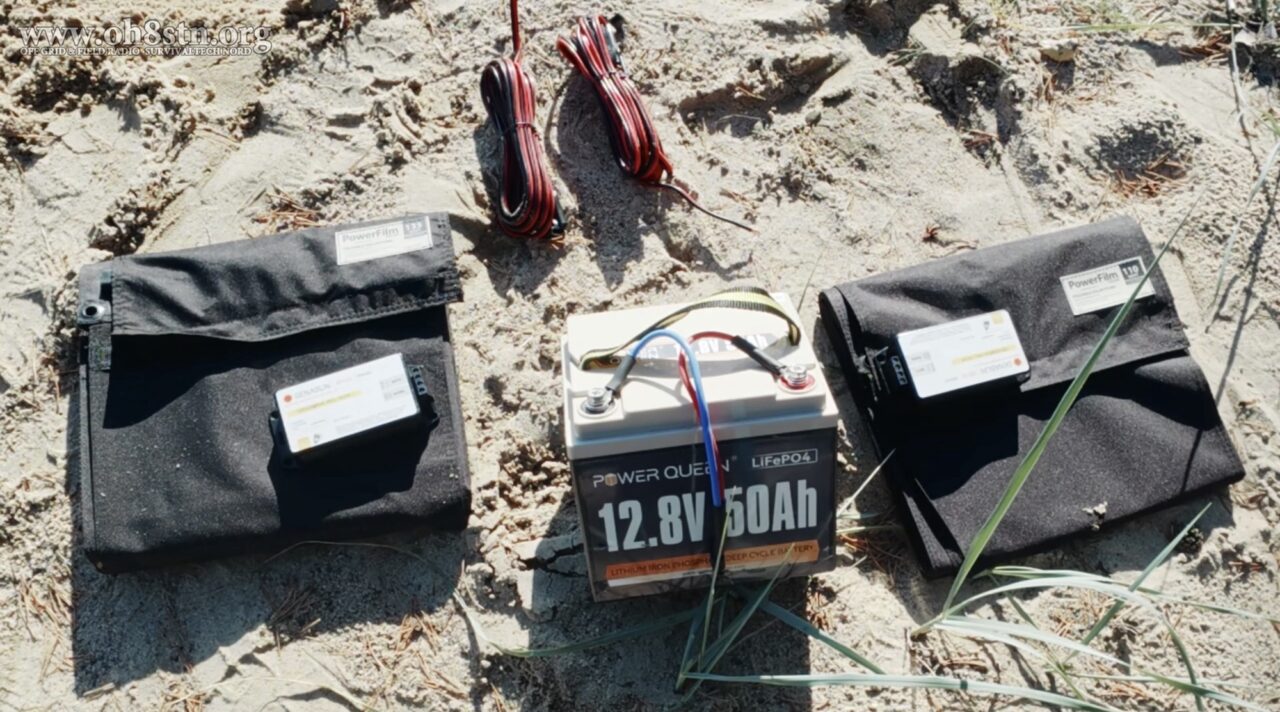
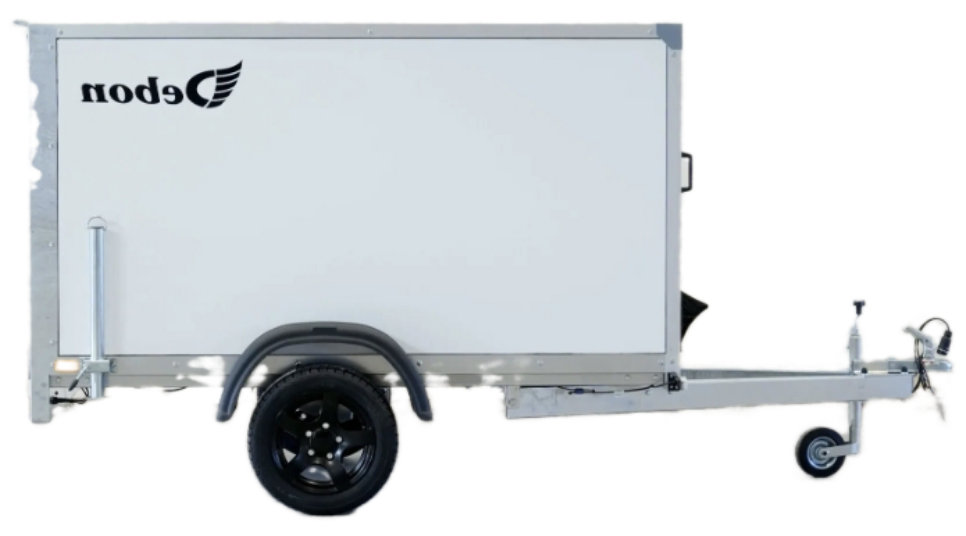
The enclosed trailer could extend this concept into a transportable radio room. It would provide weather-protected space for the Hybrid Winlink RMS Gateway, Starlink terminal, battery storage, charging equipment, and other communications gear, while the folding solar panels could be deployed outside wherever sunlight is available. This would give us a self-contained radio room on wheels that could be positioned near a disaster-relief site, search area, or regional communications hub and remain operational independently of local grid infrastructure.
Two Paths to a 100W Field Station
The Modular QRP Approach
For years, I relied on QRP radios with external amplifiers to balance power consumption and capability. I still use those systems because of their exceptionally low current consumption on both receive and transmit. In my measurements, the Icom IC-705 draws approximately 225–250mA on receive and 2–3A at its full 10W output. The Lab599 TX-500 and TX-500MP draw approximately 80–100mA on receive and 2–3A at full output.
When paired with the DIY599 PA500 Expedition amplifier, designed by Oliver DL4KA and drawing approximately 11–12A at 100W output, the IC-705, TX-500, and TX-500MP form some of the most power-efficient 100W HF systems I have used. They also remain remarkably compact and man-portable.
Field Testing the Modular System on Hailuoto Island
This modular approach is not theoretical. During a field deployment to Kirkkosalmi on Hailuoto Island, I operated Winlink and JS8Call from the Nortent Gamme 4 using the Icom IC-705 and DIY599 PA500 amplifier.
The two-operator camp used two separate PowerFilm FM16-6000LT solar panels, each connected through its own Genasun GV8-Boost charge controller. My IC-705 and PA500 station was supported by a compact 256Wh LiFePO4 power system.
That deployment demonstrated the strength of the modular QRP-plus-amplifier approach. The IC-705 kept the continuous receive load extremely low, while the PA500 provided additional transmit power when the communications path required it. Combined with lightweight solar generation and LiFePO4 storage, the entire station remained practical for a tent-based island deployment.
The Integrated IC-7300 Mk2 Approach
The Hailuoto station remains an excellent option when maximum efficiency and minimum packed size are the priorities. The IC-7300 Mk2 approaches the same mission from another direction. At approximately 0.70A on receive, it retains much of the receive-current advantage while providing the full 100W in one radio. This removes the need to combine, power, interface, and configure the separate components of a QRP radio and amplifier system.
The IC-7300 Mk2 is still not as efficient as the modular QRP systems. However, it is the most efficient integrated 100W HF solution I have used.
Why Turning Down the Transmit Power Is Not Enough
If I had a dollar for every time an Operator said, “Just turn down the output power. It is the same as a QRP radio,” I could have bought a beachfront ranch in Baja California by now.
Receive current matters because an RMS Gateway spends much of its operating time listening and waiting for incoming connections. QRP radios typically draw anywhere from roughly 100mA to 800mA on receive, depending on the radio, while many 100W radios draw between 1A and 2A. With its receive settings optimized for lower current consumption, the IC-7300 Mk2 draws approximately 0.7A on receive, placing it close to the upper end of the QRP range while retaining full 100W capability.
Reducing the transmit power of a 100W radio does not reduce its receive current. A radio drawing 2A while listening will continue drawing approximately 2A whether its transmit power is set to 5W, 10W, or 100W. Receive-current consumption is therefore one of the primary factors determining how much battery capacity the gateway requires and how long it can remain operational between charging periods.
Carrying massive lead-acid batteries into the field is inconceivable for this mission. The greater usable capacity of smaller, lighter LiFePO4 batteries, combined with an efficient HF radio, allows us to carry less weight while maintaining the operating time required to keep the gateway available.
The combination is what makes the system practical:
- Approximately 700mA receive current for prolonged monitoring
- Full 100W transmit capability when the mission requires it
- A lightweight 50Ah LiFePO4 battery
- Solar or generator charging to restore the energy consumed
Duty Cycle and Operating Efficiency
Before accounting for a single transmission, a radio drawing 2A on receive consumes 48Ah during 24 hours of continuous monitoring. The IC-7300 Mk2, drawing approximately 0.7A, consumes 16.8Ah over the same period. That is a saving of 31.2Ah every 24 hours simply by choosing the more efficient receiver.
With a 50Ah battery, the 2A radio consumes nearly the battery’s entire nominal capacity in one day of monitoring alone. The IC-7300 Mk2 consumes approximately one-third of that capacity. This is where receive-current efficiency begins reducing the battery weight, charging demand, and equipment required for the mission.
The following figures compare cumulative radio energy consumption across each operating period. Energy returned by the solar panels or generator is not included in the savings calculations.
For the following comparisons, both radios draw 20A while transmitting. The IC-7300 Mk2 draws approximately 0.7A while receiving, while the comparison radio draws 2A. The figures show how much energy the lower receive current saves and how much additional operating time that saving represents at the same duty cycle.
10% Transmit / 90% Receive
This is a useful planning model for a gateway spending most of its time monitoring for incoming connections.
The 2A receive-current radio averages 3.8A. The IC-7300 Mk2 averages 2.63A.
- 24 hours: 28.08Ah saved, providing approximately 10 hours 41 minutes of additional operating time
- 48 hours: 56.16Ah saved, providing approximately 21 hours 21 minutes of additional operating time
- 72 hours: 84.24Ah saved, providing approximately 32 hours 2 minutes of additional operating time
20% Transmit / 80% Receive
The 2A receive-current radio averages 5.6A. The IC-7300 Mk2 averages 4.56A.
- 24 hours: 24.96Ah saved, providing approximately 5 hours 28 minutes of additional operating time
- 48 hours: 49.92Ah saved, providing approximately 10 hours 57 minutes of additional operating time
- 72 hours: 74.88Ah saved, providing approximately 16 hours 25 minutes of additional operating time
30% Transmit / 70% Receive
The 2A receive-current radio averages 7.4A. The IC-7300 Mk2 averages 6.49A.
- 24 hours: 21.84Ah saved, providing approximately 3 hours 22 minutes of additional operating time
- 48 hours: 43.68Ah saved, providing approximately 6 hours 44 minutes of additional operating time
- 72 hours: 65.52Ah saved, providing approximately 10 hours 6 minutes of additional operating time
Why This System Makes Sense for the Mission
For my portable Hybrid Winlink RMS Gateway, solar power is practical through most of the year at 65° North, excluding the darkest part of winter. The IC-7300 Mk2’s shack-in-a-box design, integrated audio interface, internal antenna tuner, and low receive-current consumption make a convincing case for a simplified 100W HF field station.
The disasters we have seen during 2026 reinforce the need for this capability. The catastrophic glacial flood in Nepal demonstrated why disaster-relief teams temporarily deployed into damaged and remote areas need communications that do not depend entirely on surviving local infrastructure. Here in Finland, the same kind of gateway could connect volunteer teams searching for a missing child in remote terrain with regional communications hubs when grid-tied services are unavailable.
The IC-7300 Mk2 is not pretending to be a tiny QRP transceiver. Its advantage is that it combines manageable receive-current consumption with an integrated 100W radio. Paired with a lightweight 50Ah LiFePO4 battery and periodic charging from solar panels or a generator, it becomes a viable radio for a portable Hybrid RMS Gateway, rather than another base-station radio carried into the field.
Every amp removed from the continuous receive load reduces the battery capacity we must carry, the energy the solar panels must replace, and the time the generator must run. Combined with fewer components, fewer cables, and fewer potential points of failure, the IC-7300 Mk2 gives us a simplified 100W HF field-radio option that was not previously available in a single unit.
73
Julian OH8STN
More from OH8STN
Find my emergency communications and off-grid power books, along with my multilingual author profile, on Amazon:
Julian OH8STN on Amazon
For more practical field deployments, equipment tests, and off-grid communications tutorials, visit:
Off-Grid Ham Radio OH8STN on YouTube
