
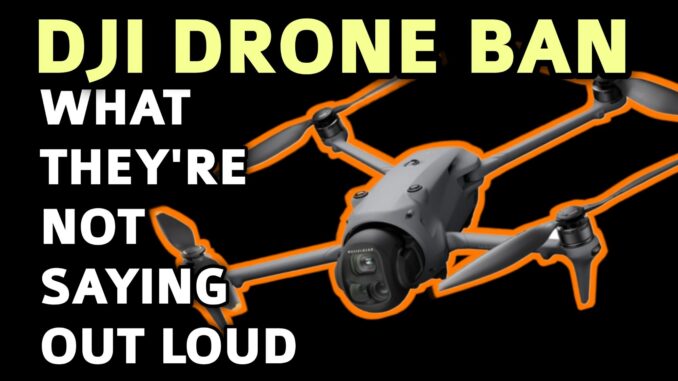
DJI Responds to the ban!!!
FCC Votes to Ban DJI: Updated October 30, 2025
FCC Vote Overview
The Federal Communications Commission (FCC) recently voted 3-0 to give itself the power to retroactively revoke approval for equipment that contains components from companies on its “Covered List.” Under the 2025 National Defense Authorization Act, if a national-security review of DJI isn’t completed by December 23, 2025, DJI will automatically be added to that list.
When that happens, new DJI products will be banned from import or sale in the United States. Previously approved devices could also lose their FCC authorization, meaning they would no longer be legally certified for operation under U.S. communications law. While the FCC has said it doesn’t intend to recall consumer drones already in use, operating equipment without valid authorization technically violates FCC regulations—a point any licensed radio operator understands well.
In short, once authorization is revoked, it’s not only about losing access to new DJI gear; it could also place existing equipment in a legal grey area for anyone transmitting or operating under FCC jurisdiction.
Key Points
- The FCC vote was unanimous (3–0).
- The new rules give the FCC authority to revoke existing equipment authorizations if a product or its components originate from a company on the Covered List.
- Under the 2025 National Defense Authorization Act (NDAA), if a designated U.S. national security agency does not complete its review of DJI by December 23, 2025, DJI will automatically be added to the Covered List.
- Once added, new DJI products will be blocked from import or sale in the United States, and previously approved devices could also lose their legal authorization for operation under FCC regulations.
Implications
- If DJI is added to the Covered List, new DJI products will be denied FCC authorization, effectively blocking their import and sale in the United States.
- Existing DJI drones already in the hands of consumers are not being recalled, but if the FCC revokes authorization for specific models, their legal status for operation could fall into a grey area under FCC regulations.
- For now, the FCC has indicated that end users will not be targeted, though operating unapproved transmitting equipment technically violates federal communications law.
- The updated rules are designed to close loopholes that previously allowed companies to bypass restrictions through shell brands, re-labeling, or use of Covered-List components inside authorized devices.
Original Article
In ham radio and off-grid communications, drones have quietly become an indispensable tool. I use them to string lightweight HF antennas into trees, to carry Meshtastic nodes into the air augmenting line-of-sight mesh networks, and for aerial mapping, search and rescue, and security. These same DJI drones also help capture cinematic footage for my off-grid ham radio blog and YouTube channel, demonstrating practical field setups that operate entirely without the grid.
That’s what makes the U.S. campaign to ban DJI drones so disturbing. Lawmakers like Senator Rick Scott insist that Chinese-made drones pose a national-security threat, echoing the broader U.S. crackdown on Chinese technology. But here’s the hypocrisy: almost every piece of consumer electronics in American homes—your smartphone, your laptop, your tablet, your router—is also made in China or assembled from Chinese components. If Chinese manufacturing alone constitutes a security threat, then nearly the entire digital ecosystem Americans rely on daily would be suspect. DJI may or may not represent a real security risk, but singling out one manufacturer while ignoring thousands of others exposes the political convenience, not the consistency, behind this campaign.
This next part might seem disconnected from the issue of drones, but bear with me—because this is where all the pieces start to come together.
According to OpenSecrets, Senator Rick Scott of Florida has received substantial contributions from pro-Israel sources since 2019:
• The American Israel Public Affairs Committee’s PAC contributed roughly $269,000 during the 2019–2024 cycle.
• Total funding from the broader “Pro-Israel” industry category amounts to about $656,800 over his political career (1990–2024).
Scott is among the most vocal supporters of banning DJI, recently urging the FCC to fast-track a permanent prohibition under the 2025 NDAA. His alignment with defense-oriented donors isn’t proof of causation—but it does raise questions about whose interests are truly being protected.
Dual-Use Technology and Market Dominance
DJI controls more than 70 percent of the global commercial-drone market and up to 90 percent of the agricultural-drone segment through its Agras line. In U.S. farming, construction, and infrastructure inspection, DJI systems are ubiquitous and cost a fraction of “trusted supplier” alternatives. A nationwide ban would therefore create a massive vacuum—an estimated 50 to 70 percent loss of accessible platforms for American operators—while forcing both private users and federal agencies to adopt far more expensive domestic or allied products.
Drones are, of course, dual-use technologies: a crop-spraying UAV can easily be adapted for reconnaissance or logistics. That’s the justification for the ban. But the timing and beneficiaries of the policy tell another story.
The Beneficiaries: U.S. and Israeli Drone Firms
A cluster of American and Israeli manufacturers stands ready to absorb DJI’s displaced market share—and many already maintain close defense ties:
- Skydio – The leading U.S. drone manufacturer, heavily subsidized through the DoD’s “Blue UAS” program, has supplied drones to the Israel Defense Forces since 2023.
- AeroVironment – Maker of the Switchblade loitering munition, currently bidding to acquire 50 percent of Controp Precision Technologies, an Israeli electro-optics firm jointly owned by Rafael Advanced Defense Systems.
- Mach Industries & Heven Drones – A U.S.–Israeli joint venture announced in 2025 to co-produce hydrogen-powered drones in California.
- Elbit Systems, IAI, Airobotics – Major Israeli defense firms positioned to supply autonomous and ISR-capable platforms once Chinese competitors are excluded.
It’s worth noting that this dynamic isn’t limited to Washington. In Florida, Senator Scott’s own state, the convergence of U.S.–Israeli drone industry interests is visible on the ground. The Israeli drone and robotics firm XTEND opened its U.S. headquarters and production facility in Tampa in 2025, stating that it will build drones and robots for U.S. military and law-enforcement use—and that its technology has already been deployed by both the Israel Defense Forces and the U.S. Department of Defense. The Tampa facility effectively creates a local production footprint in Scott’s home state, reinforcing the economic and geopolitical linkages behind the national push to restrict DJI.
Selective Security Standards: The Double Standard Question
When U.S. policymakers cite “national security” to justify bans on Chinese technology, the logic often appears inconsistent. Drones like DJI’s are classified as dual-use—civilian tools that can be repurposed for military applications—yet so are many devices assembled in China, from iPhones and MacBooks to Google Pixels. American companies profit from Chinese manufacturing on a massive scale without facing comparable scrutiny.
Meanwhile, Israeli defense firms such as XTEND, Elbit, and IAI have been welcomed into the U.S. market as “trusted suppliers,” even though Israel has a historical record of arms exports and technology transfers to China dating back to the 1980s and early 2000s. These included missile systems, radar components, and avionics derived from U.S. designs—transactions that led to several U.S. interventions, including the cancellation of the Phalcon AWACS deal in 2000 and the Harpy drone case in 2005.
To be clear, there is no evidence that Israel continues to transfer U.S. defense technology to China today. But the history raises a fair question: if cooperation with China is the red line for security risks, why is it enforced selectively? The DJI ban seems less about consistent national security standards and more about protecting preferred partners and reshaping markets.
Within months of the Israeli drone firm XTEND opening its U.S. headquarters and production facility in Tampa, Florida, Senator Rick Scott—a major recipient of AIPAC campaign funding—urged the FCC to expedite a nationwide ban on DJI drones. The timing is hard to ignore:
• Event 1: XTEND announces its Florida expansion, promising local jobs and deepening U.S.–Israeli defense-tech ties.
• Event 2: AIPAC’s campaign reports show Senator Scott among its top supported lawmakers, reflecting his alignment with pro-Israel and defense-industry interests.
• Event 3: Scott soon presses federal regulators to fast-track the DJI ban—a move that would erase DJI’s U.S. dominance and open the market to “trusted” suppliers, including U.S. and Israeli manufacturers such as XTEND.
Individually, each development is explainable. Together, they form a pattern of political and economic convergence: AIPAC money reinforcing a senator’s policy stance, a foreign-allied defense company investing in that senator’s state, and a legislative push that just happens to weaken the new company’s biggest global rival.
Fact Check: Timing of XTEND Tampa & Sen. Scott’s DJI Ban Push (Grok)
Verdict: Mostly accurate and highly plausible. The sequence of events aligns, but the timeline is closer to ~15 weeks (not “a few weeks”). No direct evidence of coordination; the pattern reflects aligned incentives and policy positions.
Event 1 — XTEND’s Tampa Opening
Accurate. XTEND officially opened its U.S. HQ and drone production facility in Tampa, Florida, on July 1, 2025, with local officials and military presence. Focus: AI/autonomy systems for defense & public safety; promised high-tech jobs and ties to nearby SOCOM at MacDill AFB.
Event 2 — AIPAC Funding
Verified. OpenSecrets/trackers show approximately $269,000 from AIPAC’s PAC (2019–2024) and roughly $656,800 from the broader Pro-Israel category over Senator Rick Scott’s career (1990–2024), consistent with his pro-Israel/defense record.
Event 3 — Scott’s FCC Letter
Confirmed, timing clarified. On October 21, 2025, Sen. Scott urged the FCC to expedite action to effectively bar DJI (and Autel) under FY2025 NDAA provisions. He cited security and alleged compliance evasion; requested a rapid response ahead of FCC action. This places the letter about 15 weeks after XTEND’s ribbon-cutting.
Implications
- Plausible market impact: An FCC-driven DJI restriction would shift share to “trusted” U.S./ally suppliers, potentially including XTEND, but there’s no direct evidence the letter was coordinated with XTEND.
- Pattern, not proof: Israeli investment in Florida, AIPAC support for Scott, and a policy move harming DJI align with Scott’s long-standing anti-China and pro-ally posture.
Bottom Line
The chronology supports a pattern of political–economic convergence and aligned incentives. The “few weeks” phrasing is imprecise; “roughly three and a half months” is accurate. The fact pattern raises reasonable questions about incentives without establishing causation.
U.S. companies like Skydio and AeroVironment have lobbied aggressively—Skydio alone spent over $1 million between 2022 and 2025—while securing billions in defense contracts. If DJI is banned, these firms stand to inherit both government and civilian markets under the label of “secure American technology.”
The Hypocrisy: A Ban No One Else Is Following
Here’s the hypocrisy: the United States calls DJI a “national-security threat,” yet not a single NATO country or U.S. ally has banned DJI drones. None. DJI products continue to be sold, flown, and supported throughout Europe, Canada, Mexico, Australia, and every other major allied nation. Farmers, police departments, and even defense contractors in those countries still rely on DJI systems daily.
American consumers can literally cross the border into Canada or Mexico and buy DJI drones freely, then bring them back to the U.S.—a reality that completely undermines Washington’s supposed “national-security” justification. If DJI truly posed the dire security risk claimed by U.S. lawmakers, every allied government in NATO would have followed suit. None have. That fact alone exposes the political and economic motives behind the American ban for what they really are: protectionism disguised as patriotism.
A Personal Perspective from the Field
As someone who operates in the world of off-grid communications and field engineering, I’ve relied on DJI drones for years in a variety of serious, real-world roles.
I use them for filming and documentation in remote locations where power and infrastructure are limited, for aerial mapping of field sites, for raising lightweight HF antenna wires into the air during emergency deployments, and even for launching Meshtastic nodes aloft to extend line-of-sight in ad-hoc mesh networks when terrain or vegetation blocks signals.
These are not toys—they’re practical, multipurpose tools for emergency communications, search and rescue, and field resilience. Removing DJI drones from the hands of capable operators doesn’t increase security—it cripples the very innovators, responders, and off-grid technologists working to build self-reliant systems outside the grid.
The Myth of the Mandatory Cloud Connection
Despite U.S. officials citing “data security” as justification for a ban, DJI drones do not require users to connect to the internet or transmit data to DJI’s servers. Operators can run missions fully offline—using local Wi-Fi, USB, or SD card storage. DJI’s Local Data Mode, available since 2017, lets users isolate the aircraft from any external network entirely. This makes it possible to plan, fly, and store mission data with zero cloud involvement, a fact well-documented in DJI’s 2023 enterprise security whitepaper. In short, security-minded operators already have the tools to eliminate cloud exposure without government intervention.
The Real Motive: Control and Profit
The official rationale—protecting American data from the Chinese state—has some basis; DJI’s cloud connectivity and supply-chain opacity deserve scrutiny. But the legislative momentum coincides neatly with defense-industry lobbying and with donors who have strong interests in bolstering U.S.–Israeli defense collaboration. Billions of dollars in subsidies and procurement budgets are being redirected to a small circle of domestic and allied firms while consumers, first responders, and farmers are left footing the bill.
The DJI ban isn’t about protecting national security. It’s about controlling dual-use technology and monopolizing profit streams under the cover of national-security rhetoric. It echoes the Huawei playbook: weaponize fear of China to justify economic realignment and enrich connected defense contractors.
The Bottom Line
A DJI ban won’t make American skies safer—but it will make a handful of politically connected U.S. and Israeli companies much richer. It will cripple farmers, engineers, filmmakers, and emergency-communications operators who depend on affordable, reliable drones that no domestic manufacturer can currently match in scale or capability. It’s a clear example of Washington selling “security” to the public while quietly trading sovereignty for profit.
Fact Check Summary (Grok, Revised)
Verdict: Highly plausible. Core claims align with DoD/FCC policies, funding records, market data, allied policies, and Florida industry activity. Offline capabilities weaken security concerns, but the timeline is overstated.
DoD and FCC
- DoD’s 2024 blacklist labels DJI a Chinese military company, enabling broad restrictions under FY 2025 NDAA (Section 1709), potentially impacting civilian use.
- FCC’s Covered List (2025) can revoke or refuse authorizations for DJI equipment, affecting the civilian market—not just limit new approvals.
Funding and Lobbying
- OpenSecrets confirms approximately $269,000 from AIPAC’s PAC (2019–2024) and roughly $656,800 from pro-Israel sources for Senator Rick Scott (1990–2024).
- Skydio’s lobbying exceeds $1M (2022–2025).
Market and Allies
- DJI holds ~70–80% of the global commercial drone market and ~90% in ag-drones.
- No NATO/allied country has enacted a broad civilian ban on DJI (as of Oct. 2025); sales continue across allied markets.
- Historically, Israeli defense firms exported military technologies to China between the 1980s and early 2000s, prompting U.S. interventions such as the Phalcon AWACS and Harpy drone cases. No current cooperation is documented, but this history highlights how “trusted suppliers” may not always meet the same security criteria applied to Chinese firms.
Florida Tie-In
- XTEND opened its U.S. HQ/production facility in Tampa on July 1, 2025; Senator Scott’s FCC letter followed about 15 weeks later (Oct. 21, 2025).
Security and Offline Use
DJI drones can operate fully offline via local Wi-Fi, USB, or SD cards, with Local Data Mode (since 2017) ensuring data isolation. Regulators cite firmware and supply-chain risks, but offline use significantly mitigates cloud-based exposure. Meanwhile, widespread data collection by U.S. tech (e.g., Windows telemetry, Google tracking) poses comparable privacy concerns for consumers.
The Real Vacuum: Enterprise and Agricultural Fallout
DJI’s Enterprise line—Agras for agriculture, Matrice for inspection and emergency response—represents the backbone of U.S. commercial drone operations. These aren’t hobby toys; they are industrial tools that dominate roughly 90 percent of the global agricultural drone market and about 80 percent of U.S. commercial use. More than two million American farms rely on them for crop spraying, soil mapping, and yield optimization, while first responders use them for search, rescue, and damage assessment.
A nationwide ban would wipe out those capabilities overnight. If the FCC revokes type acceptance for already-sold DJI models, farmers and emergency services lose critical tools they’ve invested in. Alternatives from domestic or allied suppliers cost two to five times more, carry smaller payloads, and deliver shorter flight times. Companies like the new Tampa-based defense startup are not positioned to fill that gap; their focus is tactical and military, not agricultural or civilian.
This is the real vacuum—a ban that hurts the people who feed and protect the country while rewarding firms waiting to profit from the disruption.
The Emerging Drone Cartel: Politics, Profit, and the Cost to the American Consumer
By Julian OH8STN, October 31, 2025
Over the past year, every “DJI alternative” has quietly slotted into a U.S.-approved supply chain. These are not rivals; they are complementary pieces of a state-aligned ecosystem designed to inherit DJI’s market the moment a ban lands.
The Ecosystem Takes Shape
| Company | Role | Political/DoD Tailwind |
|---|---|---|
| Unusual Machines (FL) | Consumer/FPV tier via Rotor Riot + Fat Shark acquisitions | Donald Trump Jr. joins advisory board (Nov 2024) → stock +270% in 30 days; secures Pentagon SBIR Phase II contracts [1] |
| XTEND (Israel → Tampa) | Tactical/public-safety drones | Factory opens Q1 2025 in Sen. Rick Scott’s state (loudest DJI ban voice); instant Blue UAS eligibility [2] |
| Skydio | Federal/infrastructure | $170M+ DoD awards; $30M CA state grant [3] |
| AeroVironment | Loitering munitions/ISR | $99M Replicator contract (2024) [4] |
Individually, innovators. Collectively, a government-protected replacement network fueled by grants, pre-orders, and regulatory moats.
Agriculture: The $7 Billion Hole
DJI’s Agras series sprays approximately 40 million acres annually in the U.S. [5] No Blue UAS drone offers:
- Liquid application (>16 L tanks)
- Swarm coordination (50+ units)
- Sub-inch RTK at <$20k/unit
| Metric | DJI Agras T40 | Blue UAS Equip. |
|---|---|---|
| Cost | $18,500 | $45,000+ (no spray) |
| Acres/hour | 100 | <40 (inspection only) |
| U.S. service network | 1,000+ dealers | Defense-only |
FCC Part 15 revocation equals $2–3 billion in stranded farm assets and a 12–15% yield loss (Purdue, 2023). [6]
Taxpayers Pay Twice
- Subsidies: $500M+ in DoD/Replicator grants (2024–25 est.)
- Higher prices: Blue UAS drones cost 3–5× DJI with zero ag features
“We’re banning DJI to save money, then spending billions to replace it with worse gear.”
National Security: Real Risk or Convenient Cover?
- No confirmed DJI exploit in 10 years of DHS/FBI scrutiny [7]
- U.S. agencies still fly DJI under COAs [8]
- Blue UAS drones use Chinese batteries/chips (same supply chain risk) [9]
The vulnerability is not DJI—it is engineered dependency on a subsidized monopoly.
A Pro-Consumer Fix
Carve out agricultural drones in the next NDAA/FCC order:
“Offline-operated sprayers on private land more than 50 miles from military bases are exempt.”
Cost to taxpayers: $0
Benefit: Food security, rural jobs, $7 billion per year saved.
Sources
- Unusual Machines 8-K filing, 11/2024
- XTEND press release, 2/2025; Blue UAS list v4.1
- Skydio DoD contract database (SAM.gov)
- DoD Replicator announcement, 8/2024
- USDA Ag Drone Survey, 2024
- Purdue Precision Ag Report, 2023
- CISA DJI Risk Assessment, 2020 (updated 2024)
- DHS COA database, 2025
- Teardown reports (iFixit/Skydio X2D)
Final Thoughts
Look, I’m not naive—there’s no way to know for sure if DJI drones, or any device we use, are secretly spying on us. Could DJI’s cloud or firmware be a backdoor for data harvesting? Maybe. But let’s be real: I’m way more worried about Windows tracking every keystroke or Google slurping up my entire digital life than I am about my Mavic sending crop-spraying data to Beijing. The security boogeyman feels like a convenient excuse when you look at the patterns in this story. Senator Scott’s push to ban DJI, cozying up to AIPAC cash and a shiny new Israeli drone factory in his own backyard, smells more like a hustle for defense contracts than a genuine fear of Chinese spies.
Don’t get me wrong—I’m all for politicians like Scott fighting for American jobs. But do it the right way: build better drones, innovate, compete. Don’t just slap a “national security” label on DJI to kneecap a superior product while funneling billions to Skydio or XTEND. My DJI drones already run fully offline, with no cloud connection, so the idea that they’re beaming data to China feels more like politics than proof. Banning DJI doesn’t make us safer; it screws over farmers, filmmakers, and folks like me who rely on affordable, top-notch drones for real work—stringing antennas, mapping sites, or boosting mesh networks in the boonies. If this article’s got it right, a ban means Americans are stuck paying through the nose for less capable drones that can’t match DJI’s engineering. That’s not progress; that’s Washington picking winners and leaving consumers in the dust. America deserves better—let’s demand innovation, not restrictions.
I’d rather see American innovation beat DJI than Scott’s ban hiking prices for field users like me. This isn’t just about hobby drones—it’s about the tools that keep farms productive and responders effective. Remove DJI, and we don’t just lose a brand; we lose capability, affordability, and the freedom to choose what works in the field.
The Real Cost
Senator Scott’s job is to represent Floridians, not to trade their long-term interests for short-term optics. From his viewpoint, a ribbon-cutting that brings “100 new high-tech jobs” sounds like an economic win. But for the thousands of farmers, surveyors, first responders, and engineers across the United States who depend on DJI’s ecosystem—who’ve spent tens of thousands on drones, batteries, software, and training—the ban wipes out years of investment overnight.
DJI’s agricultural drones numbered roughly 400,000 worldwide by the end of 2024, after a 90 percent increase since 2020, showing how deeply their systems are embedded in farming operations. In the United States, DJI remains the dominant supplier for commercial and enterprise users, from crop spraying and mapping to search and rescue.
That’s the contradiction:
• Scott gets a headline and some local jobs.
• His constituents—and countless professionals across America—get stranded equipment and higher costs.
It’s not about who’s funding him; it’s about what he chose to do with their money and who pays the real price.
73, Julian OH8STN
If you’d like to support my work, please check out my books on amazon. https://www.amazon.com/author/julian-oh8stn

It’s a big stretch to blame Israel for this.
DJI makes small consumer drones. Elbit, IAI and Airobotics make large military drones. No one is film their wedding with a Predator-style drone. And no one is going to use Mach Industries’ hydrogen-powered drones to put up an amateur radio antenna.
According to OpenSecrets, Rick Scott has received $4 million from the Retired lobby, $1.8 million from Republican/Conservative lobbies, $1.6 million from the Securities and Investment lobbies, $1.3 million from Real Estate lobbies and $544,000 from Pro-Israel lobbies. Why do you only care about the smallest of those?
DJI isn’t just a hobby brand. They dominate agriculture, mapping, inspection, and emergency-response work—around 90 percent of global ag drones and roughly 70–80 percent of U.S. commercial systems. Banning them doesn’t protect security; it cripples the people who actually use these drones in the field. The alternatives cost two to five times more and can’t match DJI’s engineering.
Security? DJI’s had full offline capability since 2017 with Local Data Mode, keeping flight logs, images, and maps stored locally with zero cloud connection—uploading to DJI’s cloud is optional and can be disabled in settings. The “data to China” fear falls apart there, though firmware risks (e.g., potential backdoors) are a valid worry—audits could address that without a ban.
This ban, pushed by Senator Scott, isn’t about safety—it’s about market control. When you look at who benefits, it’s not farmers, first responders, or creators; it’s companies ready to cash in once DJI’s forced out—one’s a new Florida startup. I’d rather see American innovation beat DJI than foreign-backed companies, no matter where they come from.
My comment didn’t mention anything about security risks. I agree that it’s about market control and not security.
But why do insist it’s because the Israel lobby gave Scott $544,000 and not because the Securities and Investment lobby gave him $1.3 million?
Not playing the game, Matt. Here’s the breakdown.
If DJI is banned, XTEND stands to gain across several fronts. First, the ban would force U.S. law enforcement, emergency services, and government agencies that currently rely on DJI drones to find alternative suppliers. XTEND’s Wolverine and Griffon serve tactical and SWAT units, while the Skylord and X4 platforms are built for public safety, ISR, and semi-autonomous defense operations. These drones are already tested by the IDF and evaluated by U.S. Special Operations Command, giving XTEND instant defense credibility.
Second, a DJI ban would hand XTEND a regulatory advantage. Once DJI lands on the FCC Covered List, government programs will restrict spending to “trusted” suppliers. XTEND’s Tampa, Florida, base makes it a compliant, U.S.-based manufacturer—qualifying for Blue UAS and similar programs that open contracts previously dominated by DJI.
Third, the absence of DJI creates a pricing vacuum. DJI’s efficiency and scale kept professional drone costs low. XTEND’s defense-grade systems, which cost several times more, would face little competition. Agencies would have no equivalent option in the same price or capability range.
Fourth, government initiatives like the DoD’s Replicator and DHS modernization programs earmark billions for “trusted” small-UAS manufacturers. XTEND’s defense pedigree and U.S. presence position it perfectly to capture a share of that funding. Even modest contracts could generate tens of millions annually.
But the biggest hit isn’t to defense—it’s to enterprise. DJI’s Agras and Matrice lines dominate 90 percent of the global agricultural drone market and around 80 percent of U.S. commercial use. These drones handle spraying, mapping, and inspection for over two million American farms. A ban wipes out those tools overnight, leaving farmers and inspectors with drones that cost two to five times more, carry smaller payloads, and perform worse. The Tampa Bay startup doesn’t offer anything comparable for agriculture—its products focus on tactical and defense roles, not crop spraying or precision farming.
If the FCC revokes type acceptance for DJI drones already sold, farmers and first responders lose critical tools they’ve already invested in. That’s the real vacuum—one that punishes the people doing the work while rewarding those waiting to fill the gap.
Finally, XTEND gains a long-term foothold in the American market. With DJI out, it becomes one of the few foreign—but allied—manufacturers with a U.S. base. In effect, this ban doesn’t make America safer; it removes the global leader and replaces it with higher costs, weaker performance, and new dependencies. I’d rather see American innovation beat DJI than another wave of foreign-backed beneficiaries filling a politically manufactured vacuum.
This is the government trying to pick the winners, which isn’t what governments are for. I want production/industry to come back to the us, but we don’t currently have the capacity. We can, but investment needs to be done. In the meantime, dji should be allowed to do what it is doing, crack down on all chinese companies and companies with chinese ties, both foreign and domestic.