
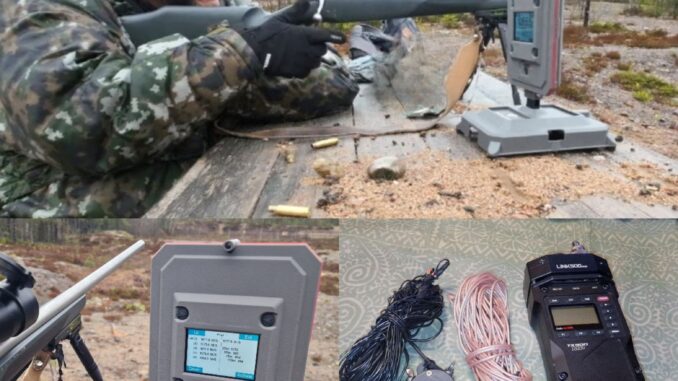
They say every society is only nine meals away from anarchy. Most of us never think about what that really means until we lose the systems and services we depend on day to day. This means we need to take every effort to cross-train, perfecting a broad range of skills, and creating redundancy where possible.
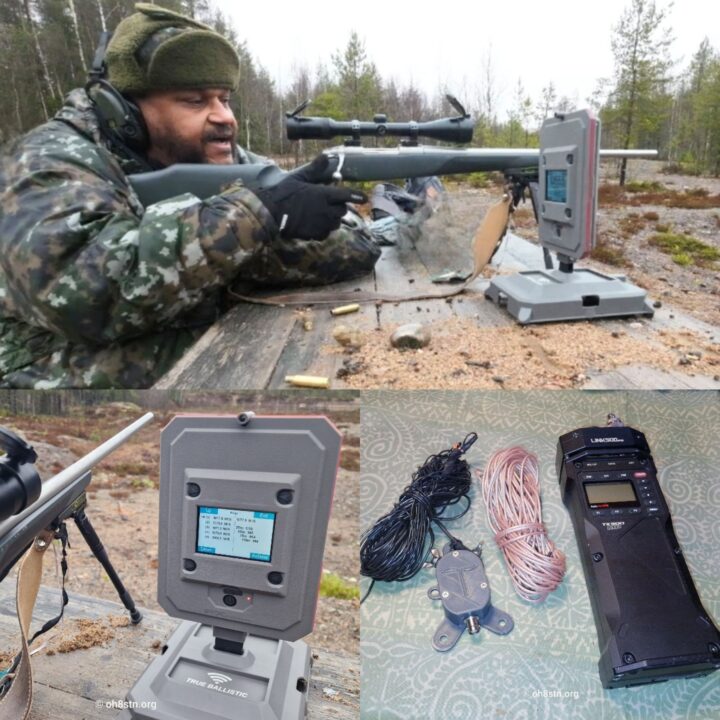
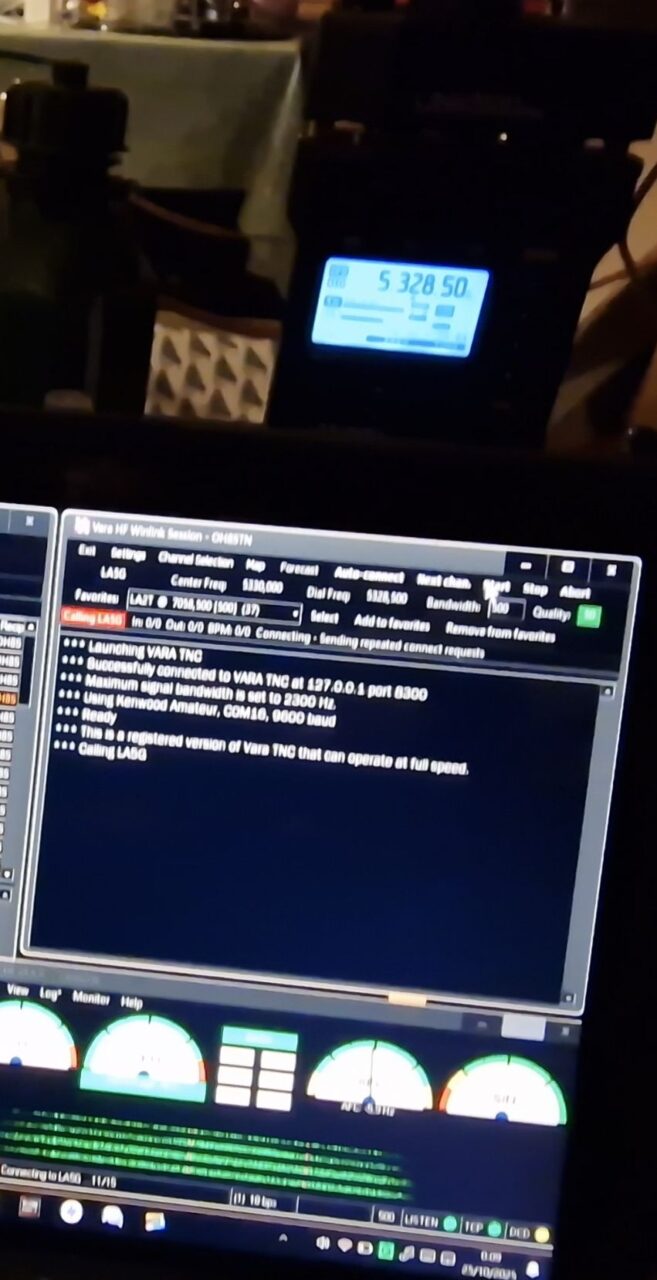
Last weekend my buddy and I headed to Puolanka, Finland, for some much-needed cross-training. Normally the focus on this channel and blog is radio communications and off-grid power. Unfortunately, radios and power are not enough on their own to keep one alive. This time we combined fieldcraft, hunting, and marksmanship to remind ourselves that redundancy in skills is the only real freedom.
Communication
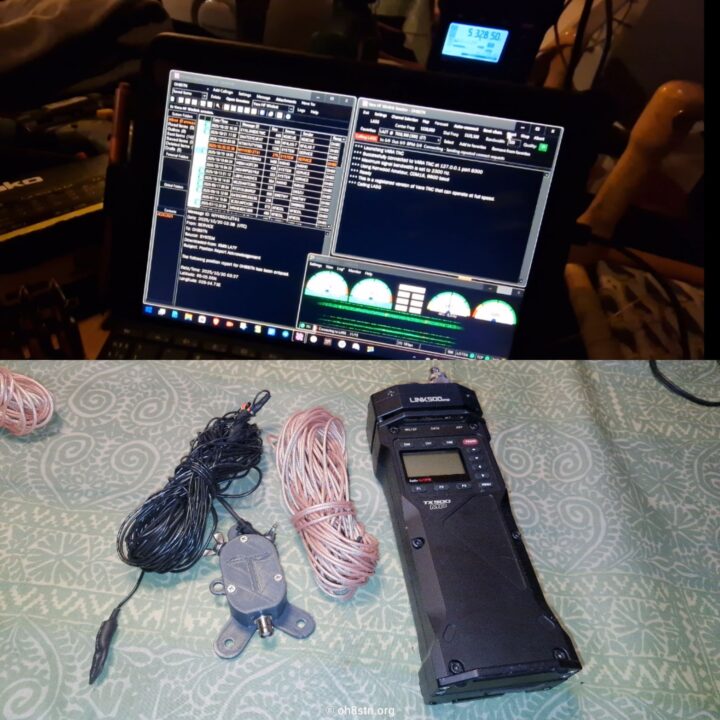
At the cabin, we set up a compact HF station using the TX-500MP, LiNK500MP, N9SAB end fed antenna, and a Microsoft Surface. We had some unique problems to solve with the location of the cabin. Being in a valley, we needed to find the best configuration to ensure local, regional, and DX communications without constantly changing setups or deploying multiple antenna systems.
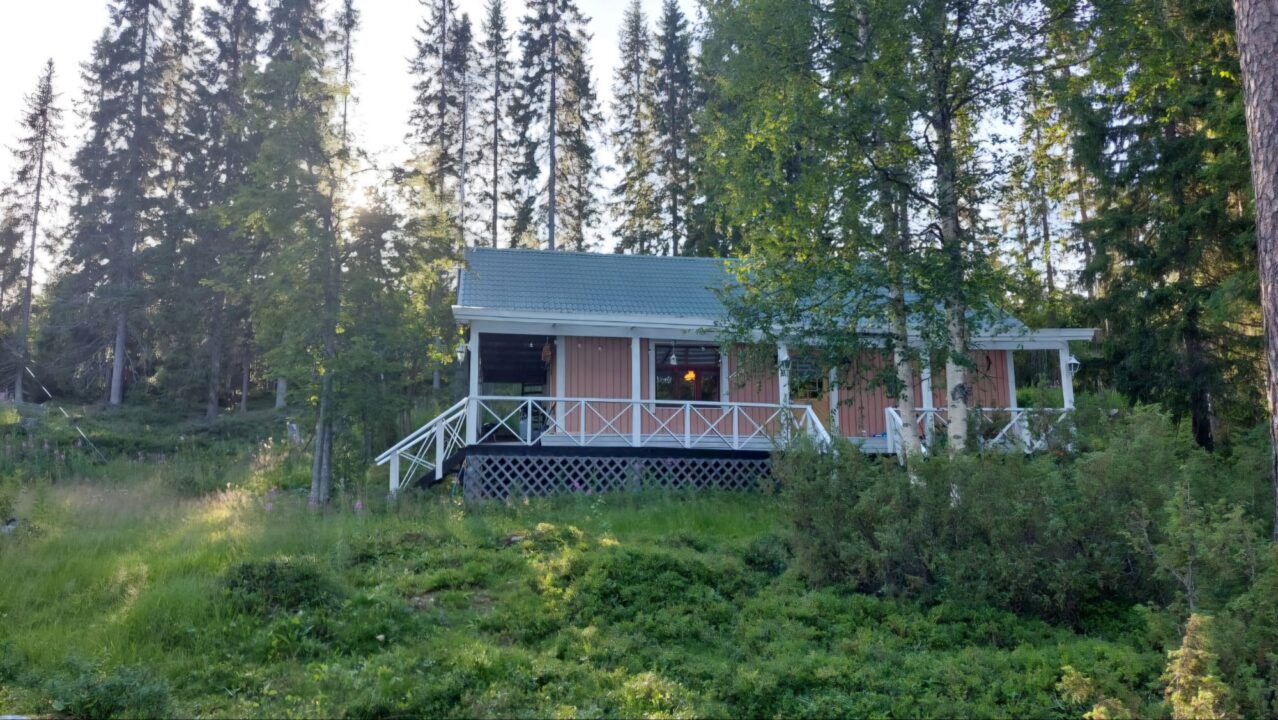
Ultimately, we deployed the N9SAB EFHW in a sloping configuration off the patio of the cabin, running out to a telescoping carbon fiber pole in the distance. The antenna was resonant on 80, 40, 20, and 10 meters, and close enough on 60 and 30 meters to tune easily with the TX-500MP’s internal antenna tuner.
Just to go back for a moment, this was our second attempt. We first deployed the antenna in an NVIS horizontal configuration to get out of the valley. That worked perfectly according to FT8, but Winlink gateways in Finland were unresponsive. As a compromise, we ran the second configuration, sloping off the cabin patio, with the end at approximately 30 ft (9 m), which allowed us to reach gateways in Norway and Russia.
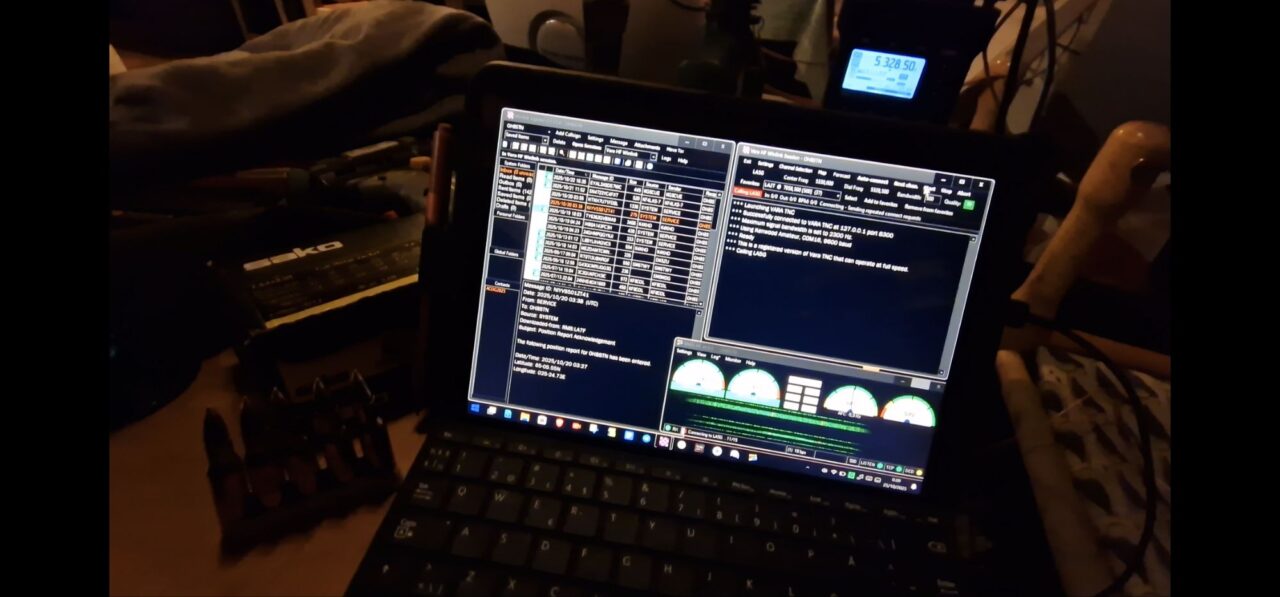
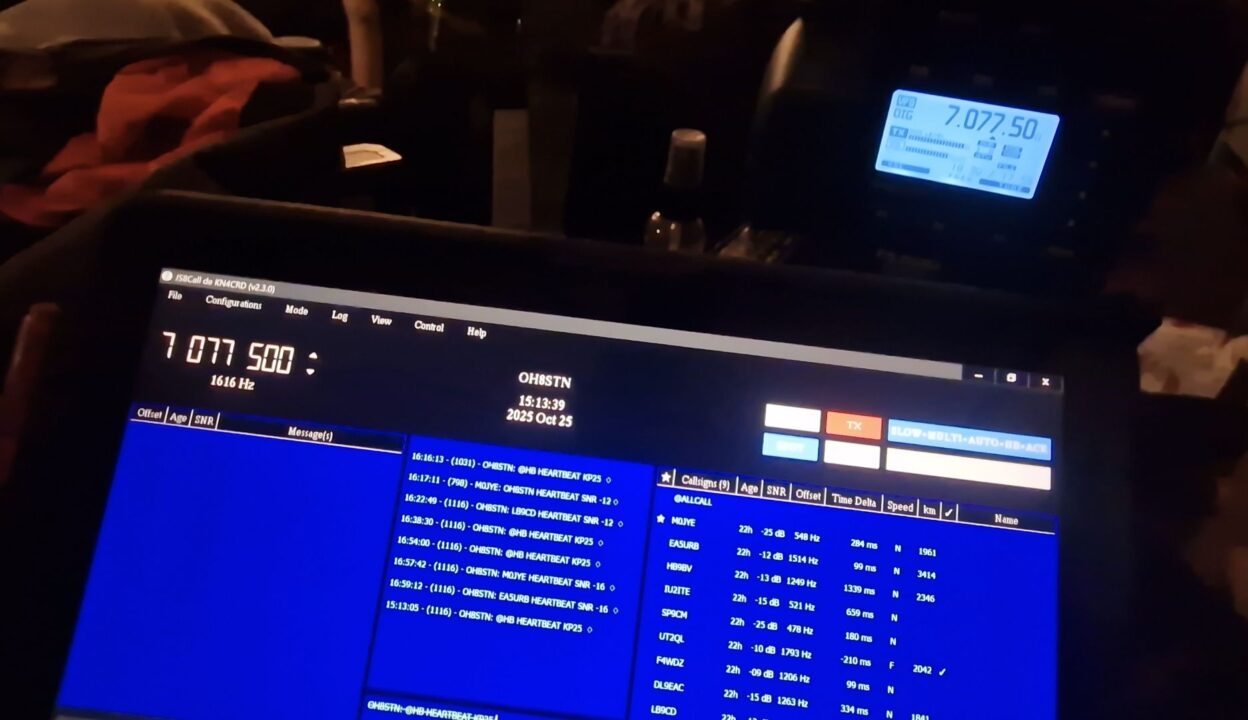
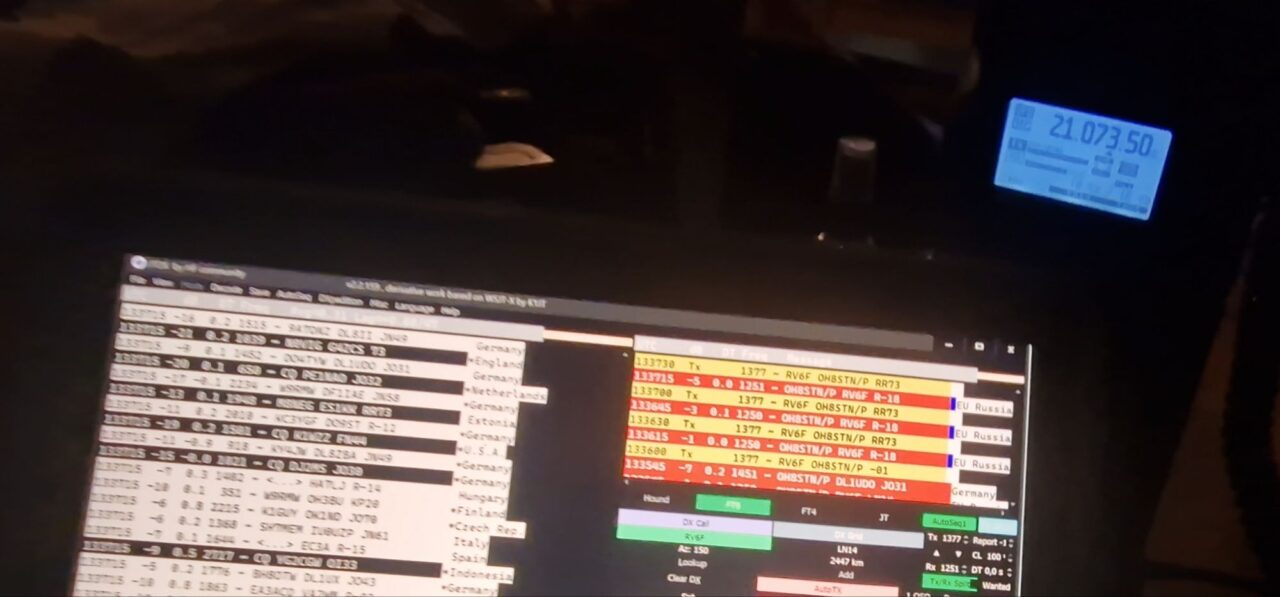
We tested the antenna with FT8, then used Winlink and JS8Call to send messages. All of this was done on 10 watts and internal batteries from a valley surrounded by foothills. The goal was simple: establish reliable communication within Scandinavia, Europe (and beyond if possible), even from an unfamiliar location under less than ideal conditions.
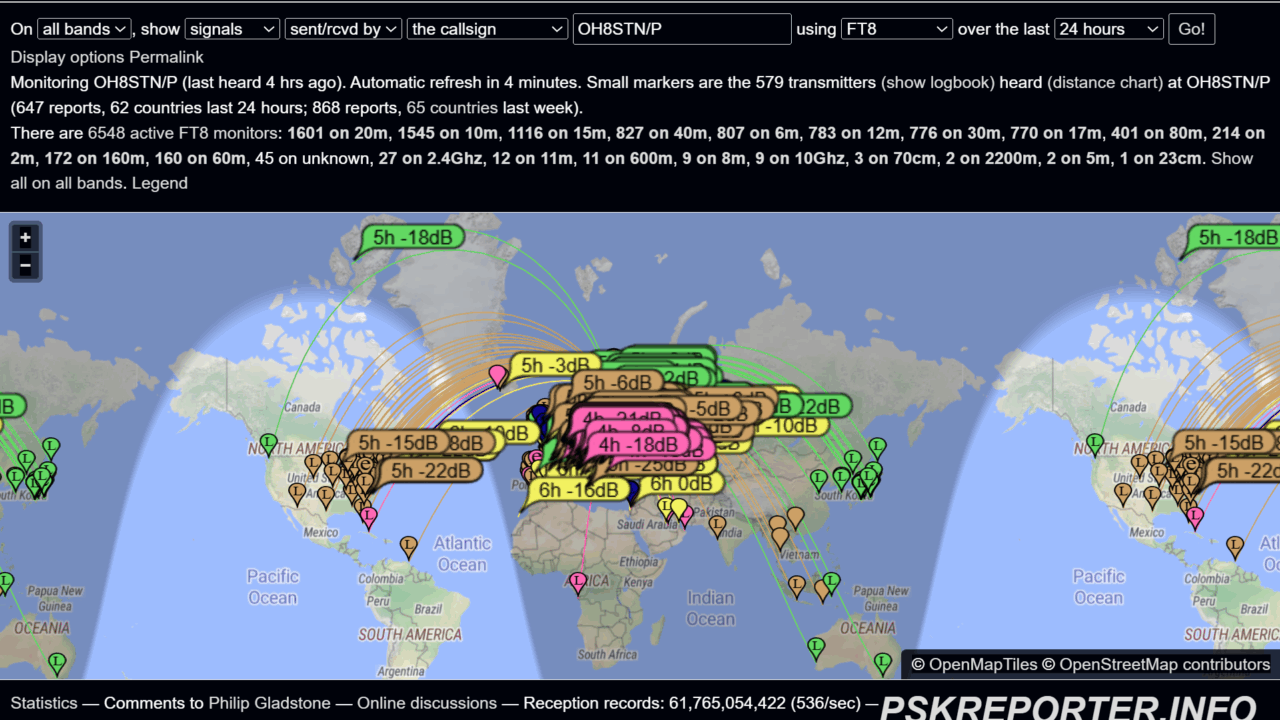
As you can see in the PSKReporter map, the station was extremely effective. The map shows both FT8 and JS8Call connections within Finland, across Scandinavia, throughout Europe, and reaching into North America and Eastern Russia. We even made contact with a station on the edge of our range in Greenland. This demonstrates the impressive capability of FT8 and JS8Call for low-power data communications.
Efficiency
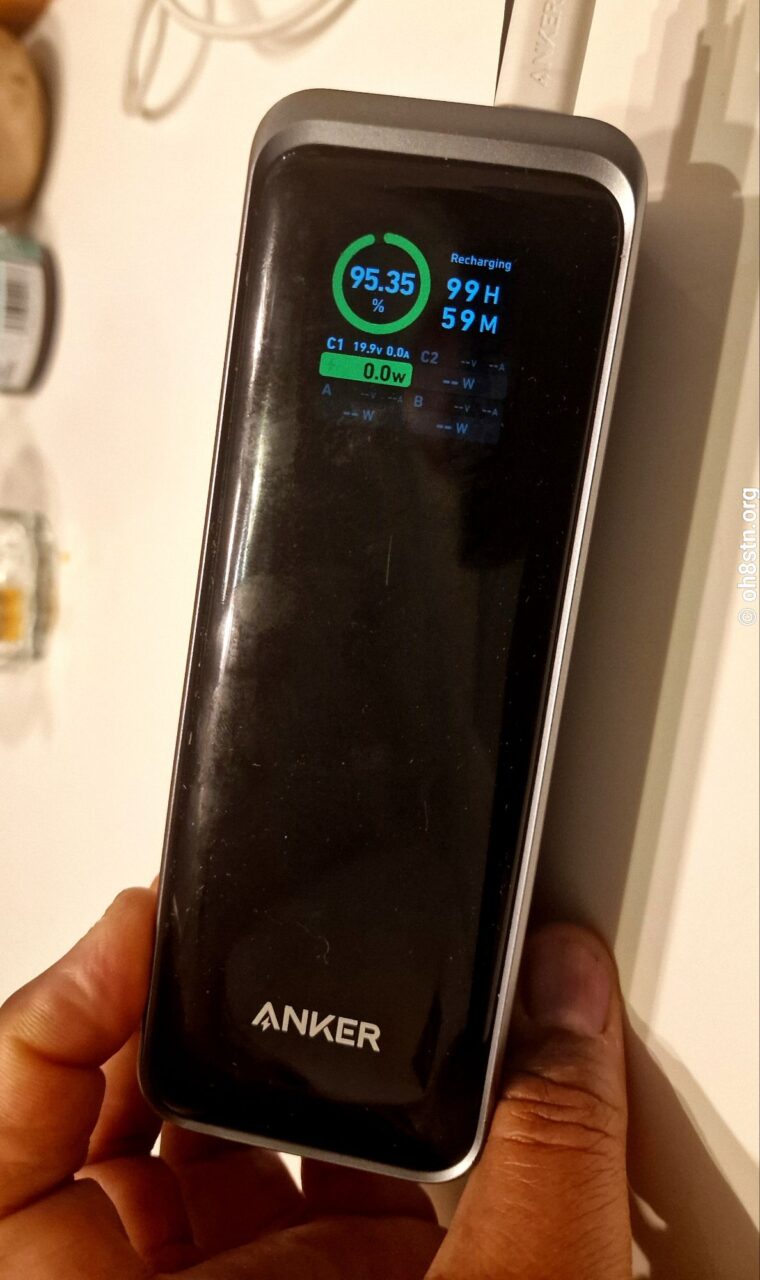
It is incredibly important to understand how critical the efficiency of our radio equipment really is. During this trip, I used the TX-500MP. It was operational from Friday morning until Sunday evening. Admittedly, it ran out of power on Sunday morning and needed a recharge, but even so, I achieved an average of about 22 hours of runtime per day. That included Winlink sessions, operating JS8Call, and running antenna tests with JTDX.
Whenever we were hunting or at the rifle range, the radio remained on and operational, usually running JS8Call. When it finally needed a recharge, I connected the Anker Prime 250 power bank to the USB-C input of the radio and brought it back to full charge.
Efficiency also extended to the antenna. For this trip, there was no reason to bring anything inefficient. With only 10 watts of output power and limited opportunities to recharge, every bit of efficiency mattered. The antenna had to do its job, getting our signal out of the valley and out to the world. The key takeaway is that runtime is not the same as efficiency. You can have great runtime, but if it requires a massive battery to achieve it, that’s a failure in the field. Big batteries add weight! Ultimately, ounces equal pounds, and pounds equal pain.
Fieldcraft
When we weren’t on the radio, we spent our time either at the local rifle range getting the dope right on our long rifles or moving through räme swamps to a makeshift OP, an observation post or hide, where we could wait for the birds of the day.
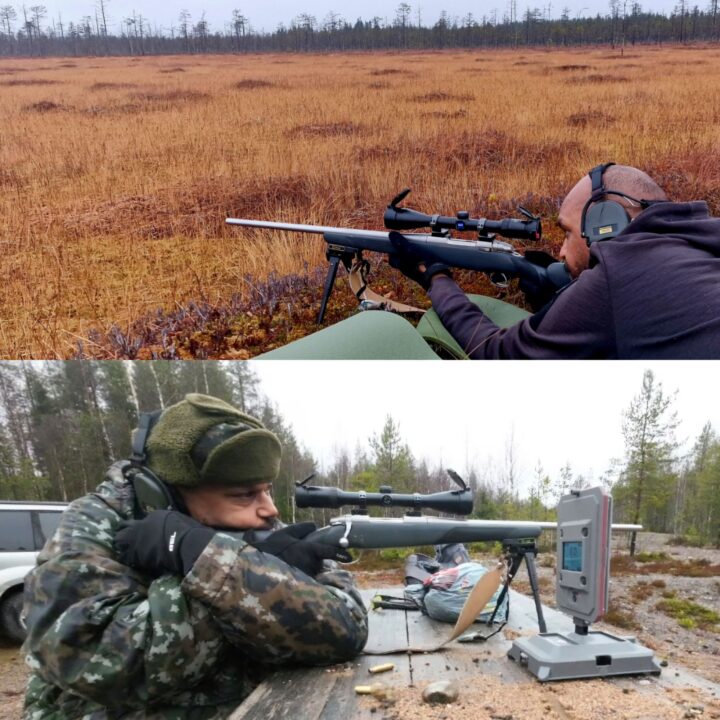
Ultimately, we harvested one black grouse along with cranberries (karpalo) from this cold, wet räme swamp. For someone who usually operates near the coast and in coastal forests, this swamp was a miserable but very important learning experience. Cold, wet, and practically floating on a sponge, it reminded us how critical it is to keep clothing and gear dry. Once you get wet, it’s only a matter of time before you become too uncomfortable to focus on observation. That lesson applies whether you’re hunting or on reconnaissance. This particular bird was chosen because it can be taken just after dawn in autumn, when black grouse perch on top of stunted Scots pines to feed, observe, and display—a sort of early morning performance to catch a girlfriend.
The importance of hunting
If we think about our dependence on the businesses and services we use each day, we are, in a sense, slaves to them. Unfortunately, it isn’t until disaster strikes, when we see empty shelves, dry gas pumps, and no natural gas or electricity to stay warm, that this point truly hits home. If we’re slaves to the grocery store, slaves to the electric company, slaves to the pharmacy, slaves to the filling station, or even slaves to our church, what are we? Dependence without redundancy is not freedom. It’s fragility. Once we understand this lesson, we can begin to see why our everyday reliance on shops and services is a flaw in itself.
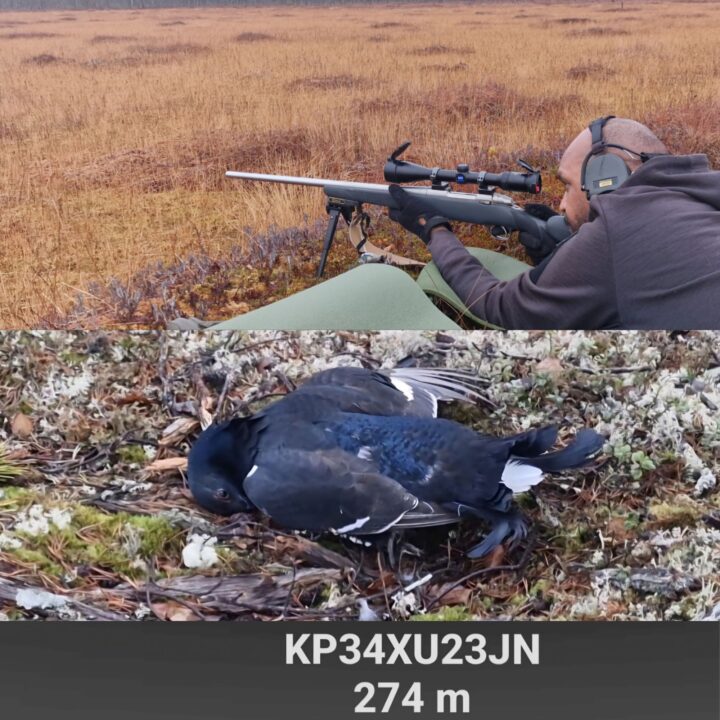
Our ability to harvest food isn’t something we can learn once SHTF. These skills must be practiced and maintained regularly. Knowing which berries and mushrooms to pick or avoid, which animals provide the most protein for the least caloric effort, and where those animals can be found throughout the year is essential for sustaining ourselves during an SHTF event or a long-term regional disaster. If we honestly expect to find food on store shelves during a disaster, we only have ourselves to blame if we can’t feed ourselves and our families.
The Rifle Range
During this weekend excursion, we also spent some time at the range. Range time is important for several reasons. First, marksmanship is a perishable skill. If we don’t maintain it, we may not be ready when those skills are needed. Getting to the range helps us stay comfortable with the rifle, fine-tune the dope, and understand the true capabilities of our long guns. Many of us learn these lessons early on from older family members through hunting or time on the range. Others, like myself, develop these skills in the military, for example in the Marine Corps.
This brings us to “dope”, and why we invested some time at the range. Getting the dope means more than punching holes through a target. It is live-fire work to confirm zero, measure group sizes at known distances, record wind, temperature, and elevation effects, and write those calculated corrections on a dope card so the rifle performs predictably when it matters. In this case, were set up for 100 meters (about 109 yards).
Dope is a backronym for the key data needed to adjust rifle fire onto a target at long range. Direction means wind direction. Open means the range to the target, often expressed in meters, and the moment you open the bolt to start the dope process. Pitch means the elevation adjustment in mils or MOA. Elevation means the vertical hold.
It is also written on a dope card taped to the rifle stock and contains pre-calculated ballistics for different distances, wind speeds, and altitudes.
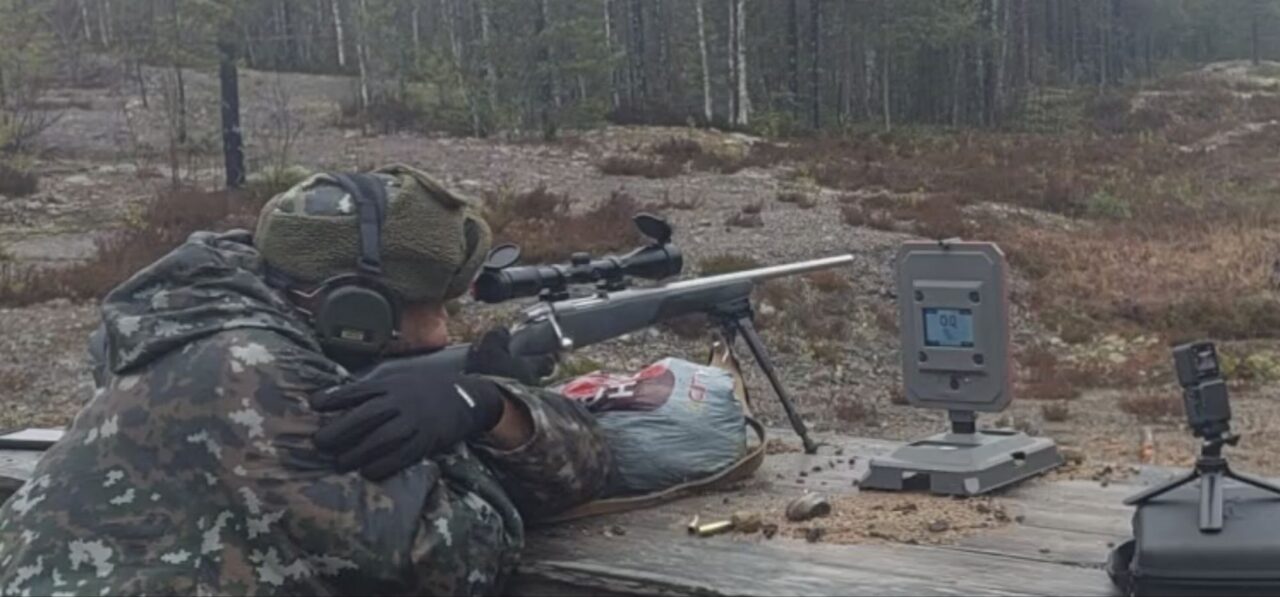
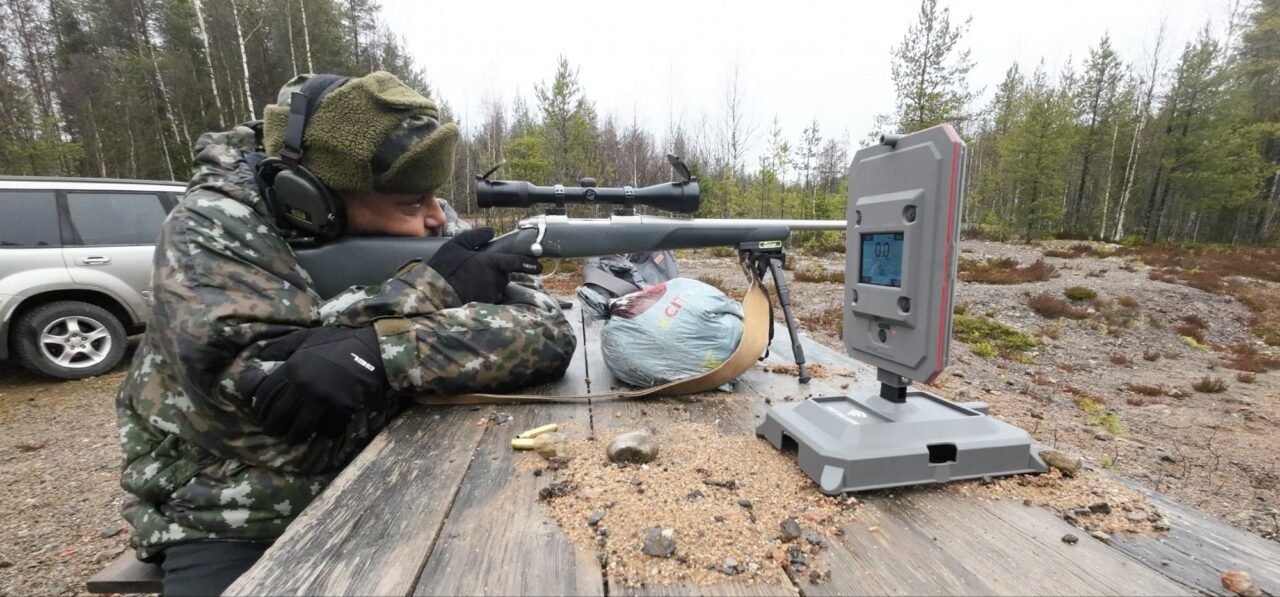
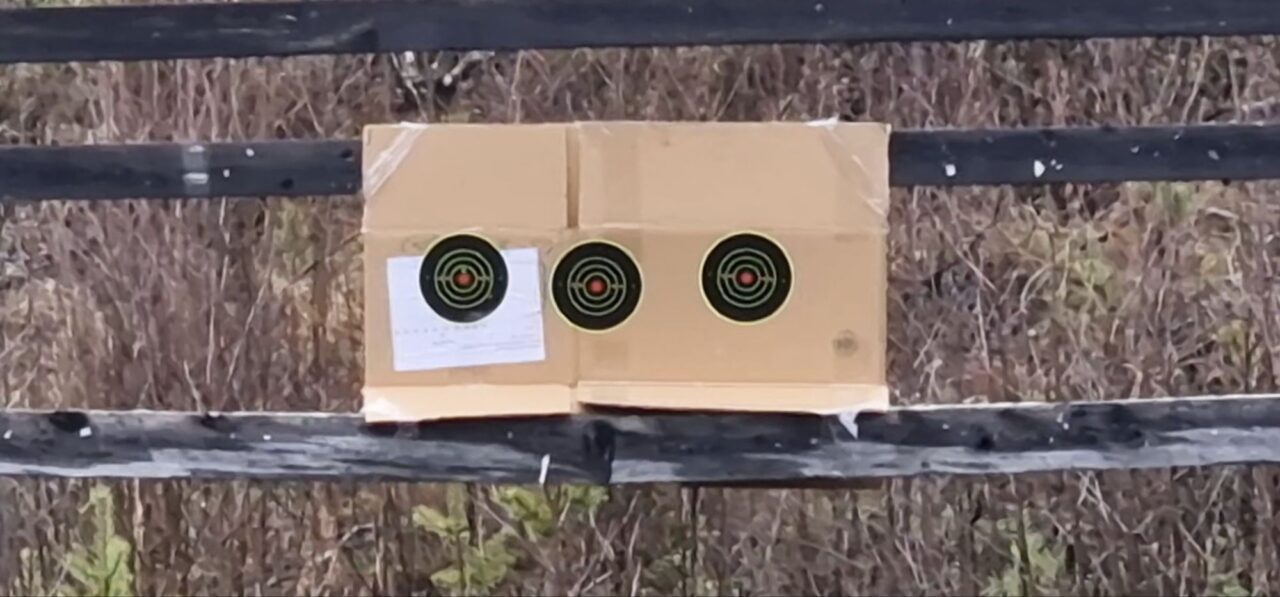
On the range I used the Sako 75 .22-250, which was an absolute monster. I also put some rounds downrange with the 7.62x53R, but I forgot to get more images.
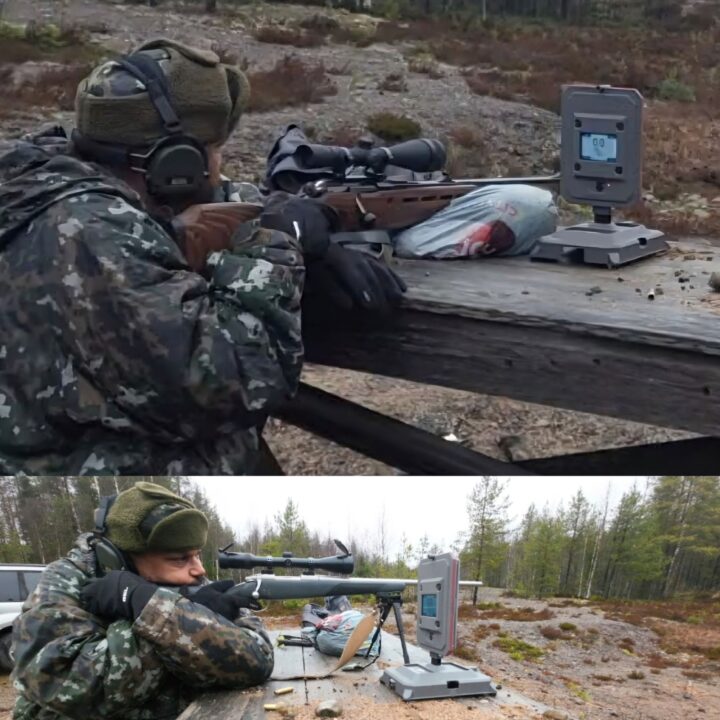
Our goal was putting quite a few rounds downrange to measure point of impact, group size and to measure speed and energy at known ranges with standard and hand loaded rounds.
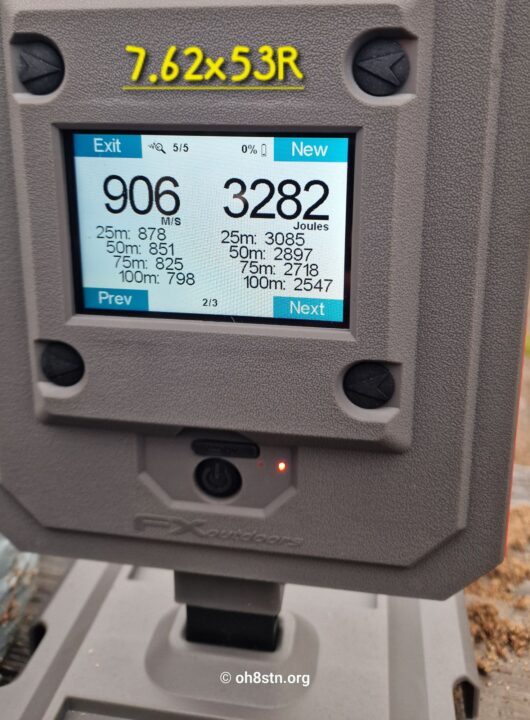
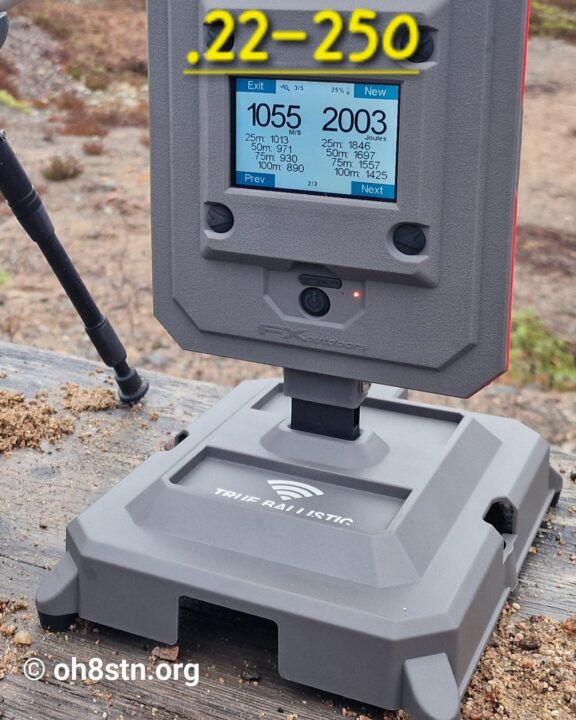
Above we have the results of the FX True Ballistic Chronograph. There were many more shots, but the results from these strings tell an interesting story about our capabilities downrange.
Sako 75, .22-250 : What the numbers show
Average velocity on the radar: 1055 m/s (3460 fps). Measured velocities downrange: 25 m = 1013 m/s (3323 fps), 50 m = 971 m/s (3185 fps), 75 m = 930 m/s (3051 fps), 100 m = 890 m/s (2920 fps). Energy trend: 25 m ≈ 1846 J (1361 ft-lb), 50 m ≈ 1697 J (1252 ft-lb), 75 m ≈ 1557 J (1149 ft-lb), 100 m ≈ 1425 J (1052 ft-lb).
What this means in the field
This is a very fast, flat-shooting precision load. The high muzzle velocity and modest velocity decay (tested at 100 m, about 109 yd) give a flat trajectory and small holdovers at common hunting and target distances. I use this load for precise range work rather than relying on instinct, and for small to medium game where a light, fast bullet is appropriate. I record the exact velocities and point of impact on a dope card for that rifle and that specific load to simplify holdovers at various ranges (meters and yards). I never assume the same dope applies to any other bullet or handload.
7.62×53R: What the numbers show
Average velocity on the radar: 906 m/s (2,972 fps). Measured velocities downrange: 25 m = 878 m/s (2,880 fps), 50 m = 851 m/s (2,792 fps), 75 m = 825 m/s (2,707 fps), 100 m = 798 m/s (2,620 fps). Energy trend: 25 m ≈ 3085 J (2,274 ft-lb), 50 m ≈ 2897 J (2,136 ft-lb), 75 m ≈ 2718 J (2,003 ft-lb), 100 m ≈ 2547 J (1,877 ft-lb).
What this means in the field
This is a heavy, high-energy round. Compared with the .22-250 it delivers far more terminal energy at all measured ranges. Expect a more arcing trajectory than the .22-250 and more pronounced recoil, but it has substantially greater stopping power and retained energy on game. I use this round when energy on impact and humane terminal performance matter more than absolute flatness of trajectory. I may record zero, group sizes, and wind holds for this rifle and this factory load so I know what to expect downrange at various distances.
Practical takeaways
Every load needs its own dope. After range testing I label the chronograph photos and results with rifle, cartridge, load type, shot count, and average velocity. That single step prevents stupid mistakes later. Use the .22-250 for flat, precise work at 100m (about 109 yd) and for minimal meat damage. Use the 7.62×53R when you want energy on target and humane stopping power on larger game. Subsonic handloads are a separate animal; do not mix their dope with supersonic data. We measured speed and energy for the subsonic rounds, but those results are not shown here. Chronograph subsonic rounds and make a separate dope card. Put the numbers on paper: velocity at a known distance (meters and yards), zero, and typical wind holds. That is the difference between a long-range guess and a correct first shot.
Final thoughts
The weekend covered communications, fieldcraft, and marksmanship. There were quite a few challenges, but for the most part we overcame them all.
The first challenge was getting our signals out of the valley, over the foothills, and out to the world. There were no repeaters, and LOS communications on VHF/UHF would have been a waste of time. Understanding the pros, cons, and capabilities of each antenna configuration turned guesswork into a “right on the second try” success. Assuming that simply putting up a dipole or an end-fed without considering the surrounding geography is a fast route to failure. Knowing which antenna will get our signals to the people we need to reach, and at what range, can only be learned through field testing and experience.
The rifle range gave us hands-on experience with a rifle I had not used in the field before. We got comfortable with its handling, learned how strong the recoil was, and observed what the round did downrange. For a rifle that is new to you, range time builds essential muscle memory for loading, operating the bolt, and adjusting the optic for your preferred distances. All of this happens without the stress of doing it for the first time during a hunt.
Finally, the hunt is not just about harvesting food. The hunt teaches quiet movement through the forest and swamp. It reveals what gear we truly need to carry and what can be left behind. For example, we didn’t take any radio gear to the OP. Since there were two of us supporting one another, and no one within radio range to hear us even if we called, leaving that equipment behind saved unnecessary weight and effort. That was one lesson. Another was learning to be comfortable with being uncomfortable.
It was cold, wet, and difficult to find a stable firing position. Even so, we stayed there for several hours—quiet, patient, marking potential targets, and observing the area without startling a possible harvest. Despite the discomfort, maintaining discipline and staying still made the effort worthwhile. Start complaining, fidgeting with a phone, or letting attention drift, and the opportunity is gone.
Each hunting trip is field experience, whether or not we harvest anything. Every outing adds to our understanding of the terrain, the wildlife, and ourselves.
Communicate, hunt, communicate!
We started and ended each day sending and receiving Winlink messages. Special thanks to X users @wyomingsurvival and @SuperFreqz, who were kind enough to exchange messages with me during this trip. Even when other things were happening during the day, coming back to a stack of Winlink messages always lifted the mood, especially if the harvest didn’t go as planned. Communication is important!
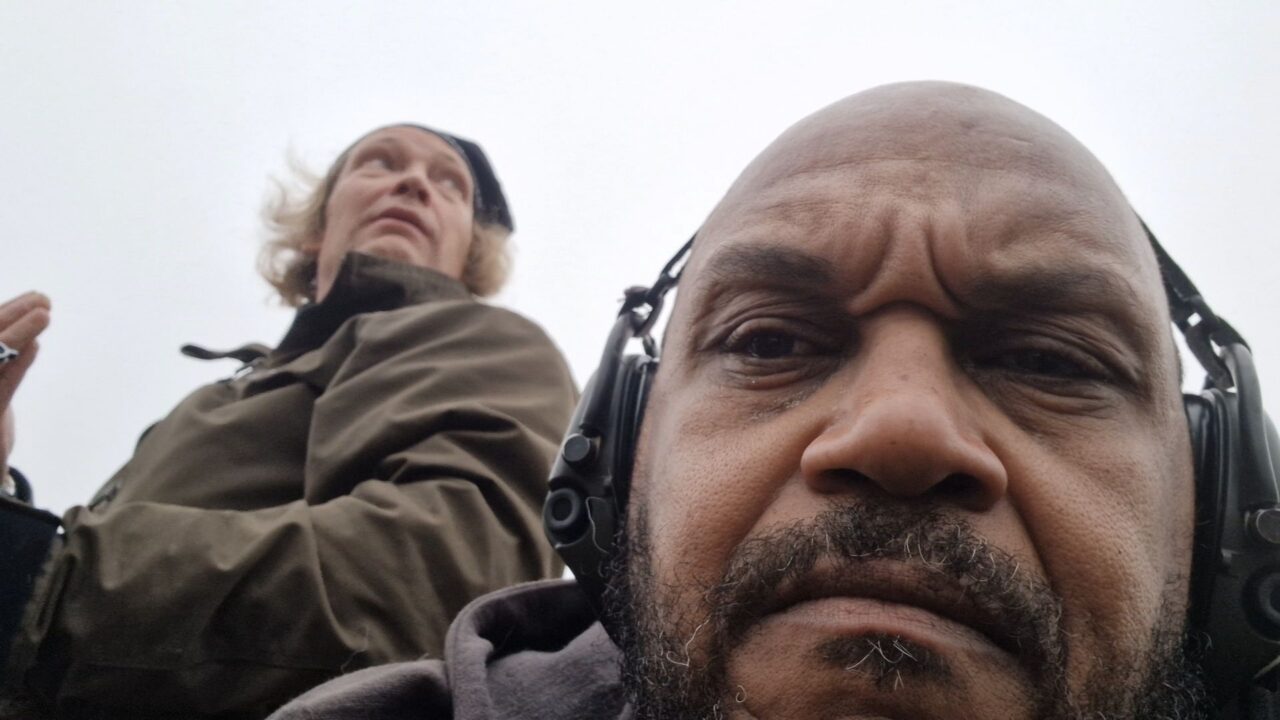
Huge thanks to my buddy Mikko for taking the time to exchange skills with me. These exchanges of knowledge aren’t always easy, but when done right, our community thrives.

If you’d like to support my work try one of my books on Amazon.
73
Julian, OH8STN

Leave a Reply